Posts

What Is Talked About During Marriage Counseling?

Nervous about your first marriage counseling session? You’re not alone. Marriage counseling is an extremely vulnerable experience, bound to unearth intense emotions for everyone involved. Fortunately, if you and your partner know what to expect before you begin, it can feel a lot less scary—and you’ll likely get more out of the experience. So, how do couples prepare for a therapy session? Although the specifics of your marriage/ couples therapy exercises will differ depending on your unique goals, there are some basic steps you can take to ready yourself for any initial therapy session. 

To help prepare you for your healing journey, Well Marriage Center answered a few of the most common marriage counseling questions that couples ask when starting therapy

Frequently Asked Marriage Counseling Session Questions

What Do You Talk About Before Couples Counseling?

Naturally, every couple’s reasons for pursuing therapy differ. However, there are common factors that often contribute to strife in a relationship, such as:

  • Communication issues
  • Loss of romantic feelings
  • Financial issues
  • How to raise children 
  • Health issues
  • Trauma  
  • Intimacy issues
  • Infidelity

If there are clear stressors—like those listed above—that you and your partner deem the main source of tension, then it would be best to review those points before your first therapy session. 

However, if your reasoning is less cut and dry, then it maybe is beneficial for you both to explore the following questions before starting therapy: 

  • Do we want to stay together? 
  • What are your opinions of therapy?
  • What are the most significant problems in our marriage? 
  • Does this rough patch/relationship feel temporary or permanent?
  • When did you first notice that something was wrong? 

Going through these questions can give you a better idea of how to navigate counseling. It’s important to note that you do not need concrete answers so long as you both actively engage with these questions on a deeper emotional level. 

Additionally, reviewing these types of questions in advance will better prepare you and your partner to have difficult conversations, making your first counseling experience more productive and beneficial for everyone.

What Do You Talk About During Marriage Counseling?

As we’ve said before, the specific topics of each counseling session vary greatly depending on the couple’s unique goals and challenges. Every couple is different, so every counseling approach is equally distinctive. That being said, here are a few of the most common questions a good therapist  asks during an initial counseling session. 

  • In general, how would you describe your life and marriage together?
  • What does the timeline of your relationship look like? 
  • What strengths do you bring to the table in your relationship? And what strengths do you think your partner has? 
  • Do you have any prior experience with marriage counseling or other types of therapy?
  • What made you decide to seek marriage counseling?
  • Have you tried anything to resolve present issues before seeking counseling? What did you try, and how did that go?
  • What do you expect to get out of couples therapy? 
  • Do you currently want to stay with your partner? Why or why not? 
  • Are you willing to put in the work and make changes to improve the quality of your marriage?

Is There a Difference Between Couples Therapy vs Marriage Counseling?

This depends on who you ask, but Well Marriage Center uses these terms interchangeably. We believe that all couples, legally married or not, can repair and strengthen their relationships via therapy. Ultimately, the end goal of therapy for all types of couples is the same—to heal, reinforce their relationship, and bring about a happier future together. 

How Long Do Couples Usually Go to Counseling?

The actual duration of couples counseling is different for everyone and depends on several factors, like:

  • How long you have been together
  • What your needs are
  • What challenges are present
  • The counseling model used by the therapist

In the end, the average length of marriage counseling doesn’t matter. A couple may pursue counseling for as long as they need to; incorporating a strict timeline doesn’t do anyone any favors, and may add unnecessary stress. 

Searching For Pro-Relationship Counseling? Try Well Marriage Center

It’s important to understand that pursuing counseling does not mean you have failed as a couple. Instead, it’s a chance to make your relationship even stronger. Regardless of your specific situation, you and your partner deserve a therapist who will help you pursue individual happiness while advocating for the success of your relationship. 

Although counseling can feel daunting, the right therapist will help you and your partner work through the tension to build a stronger and happier union. Our licensed, specialized therapists know how to tailor your therapy experience so you and your partner can discover mutually beneficial solutions. 

If you are both ready to take the first step of your counseling journey, fill out our short intake form and set up a consultation with our Intake Coordinator, Melinda. She’ll happily walk you through our process and answer any questions you have to match you with a counselor who meets your unique needs. 


What a Marriage Counselor Should Not Say

While some reports show that marriage counseling has a positive impact on 70% of couples, the journey to healing your relationship is not always easy. Even if you and your partner agree that therapy is the best move, the connection you have with your counselor can profoundly impact the health of your relationship with your partner as well. It’s hard enough to find a therapist in the first place, and then it can also be difficult to know how to evaluate them. It is also not common for couples that are new to counseling to know that they can leave their therapist, and find a new one. They are ultimately there to serve you and your needs, not the other way around. That is what has motivated us to create this piece on marriage counseling: what not to say. We want couples to have more confidence in being able to identify if they are in the right place to heal their relationship. 

What Are the Signs of a Bad Couples Therapist?

It can be easy to attribute the problems with couples therapy to the pair seeking help. This can lead couples to stay with the wrong therapist much longer than they should. Let’s take a look at some of the signs of a bad couples therapist.

  • Uses Too Much Jargon: Your therapist is not there to confuse you and show off that they have a degree. The language they use in sessions should be to help you discover the root cause of your issue(s) and progress to a positive future. The best help a counselor can give you is to guide you and your spouse through whatever challenges your marriage is facing without resorting to jargon that you don’t understand.
  • Has Little or No Structure: Couples therapy needs to be conducted in a structured environment, with a clear cut plan and a positive end goal for the relationship. Before you meet with a counselor, ask them how they structure their sessions. They need to step in and give ample time for each person to speak their mind. There are too many emotions in play for a therapist to sit back and let the couple talk in circles for the whole session.
  • Treats All Couples the Same: Inexperienced counselors will use similar treatment methods from couple to couple. While some healthy habits and practices can be recommended to couples across various circumstances, you want your therapist to treat your unique situation as such. The special dynamics of your relationship may fit a certain strategy on paper, but the right therapist will customize their process to fit your situation.
  • Is Not Pro-Relationship: Whether or not you are married, counselors that push for divorce or breaking up as the top solution for your relationship may be too focused on you as an individual and not as a couple. So, what does pro-relationship counseling look like? Other therapists may practice what is called “marriage-neutral counseling.” This means the therapist will take a neutral approach toward whether or not you and your partner should stay together. Within these kinds of sessions, it is not uncommon for the counselor to encourage couples to split up rather than put in the work to better their relationship. 

Can Couples Counseling Make Things Worse?

Simply put no, marriage counseling will not make things worse. The catch is that both parties must be willing to put in the work to fix the issues. However, there are therapists that can cause damage to your marriage and even you and your partner’s mental health. It all comes down to your work and how well you and your partner connect with your counselor. Although it’s not always easy to spot the signs of an ineffective counselor, if something feels off, talk to your partner and listen to yourself if the sessions just are not feeling right. Perhaps you’ll discover you’ve both been searching online, “when to stop marriage counseling” because neither of you feels you’ve made any progress after numerous sessions.

This can all sound a bit bleak, but before you jump the ship on counseling altogether, a shift in who you go to might be all the change you need. For example, if you feel your current counselor is discussing divorce too much, it would be a good idea to go to a team that practices pro-relationship therapy like Well Marriage Center.

What are the Signs Marriage Counseling is Working?

 With a better understanding of what a bad situation can be, here are some clues that your counselor is a good fit: 

  • It Feels like Collaboration: You should feel like the therapist is on your team. For example, are they asking the right questions, are they truly wanting to get to know you both, do they demonstrate a good understanding of your relationship after multiple sessions, and are they focusing on the strengths of your relationship? If your couples therapist is taking sides, that is a sign that healing in your relationship will likely not occur. 
  • You Don’t Dread Going: If you and your partner are excited about going to therapy to work on creating the best situation, that is a great sign it is going well. Dreading going to counseling because you feel like all it does is start conflict could mean that your current session environment is not conducive to healing the relationship. 
  • You Are Doing the Work at Home: It is a great sign if all the hard work both of you put in does not end when you leave the session. You should be excited to put what you have been learning and practicing in therapy into action. When your therapist gives you a mindfulness activity to try the next time an argument starts, both parties should be excited to pause and implement it. 

Well Marriage Center: Where Happy Futures Begin

When you invest in relationship counseling with one of our therapists at Well Marriage Center, you can trust you’re getting paired with certified therapists that have a wide range of treatment frameworks. It can also put your mind at ease that all of our therapists have dedicated their careers to solely helping couples forward.  It is always beneficial to have a marriage counselor in your community: one who is deeply experienced with the nuances of committed partner relationships and who wants to see your marriage succeed and thrive. 

Contact us today to set up a consultation with our Intake Coordinator, Melinda. She is ready and waiting to answer any questions you may have to ensure you are matched with the right counselor. 


What Should I Not Tell a Marriage Counselor?

All relationships go through phases. Sometimes, you’re perfectly in sync with your partner and your personalities just click. You are open when communicating with each other, and you are excited to celebrate their wins or weather their losses together. Then there are times when you can’t seem to agree on anything. Whether it’s spending habits or how they chew, sometimes your partner just irritates you. There are also the times in between, when you and your partner settle into your routines. You may start to feel more like coworkers and roommates while doing chores, running errands, or raising kids and pets. Whichever stage you’re in, you’re not alone. Couples across the globe struggle to keep the spark alive when everyday life gets in the way.

And, while you’re not alone in your experience, you also don’t have to be alone in working toward a more solid relationship. That’s where marriage counseling comes in. In fact, 49% of couples have attended some form of counseling with their partner, even if they aren’t married. A growing number of couples are seeing the benefits that sessions can have on their relationships, such as improving communication, identifying the root causes of conflicts, and strengthening emotional and physical intimacy. Yet, it’s not uncommon to feel hesitant to open up about your private life to a professional. Lacking answers to questions like “What do you say at marriage counseling?” and “Why does marriage counseling fail?” can prevent couples from seeking help, even when they truly need it. 

At Well Marriage Center, our goal is to make the benefits of couples therapy accessible to all, so we’ve put together this guide on marriage counseling: what not to say

What Not To Say During Couples Counseling?

While you shouldn’t hide anything from your couples therapist, there are certain phrases or ways of saying things that will harm your relationship further instead of healing it. Oftentimes, these phrases are ways of lashing out about problems rather than identifying and working to solve them, which causes both sides to feel worse after marriage counseling. Here’s a list of phrases you should avoid in favor of more reflective ones:  

“No, You’re Wrong…”

While both you and your partner should feel comfortable expressing how you feel, shutting down the other party’s perspective or playing the blame game closes off communication and leaves no room for growth. The same situation could be interpreted completely differently by you and your partner. If they start to open up about what they experienced and you interrupt with “You’re wrong,” you won’t get the chance to understand their perspective. You don’t necessarily have to agree with your partner’s version of events, but it helps to know what they are in order to get to the root cause of your disconnect. 

“Don’t Tell My Partner This…”

You don’t want to create a situation with your couples therapist taking sides. Asking your therapist to keep a secret from your partner can put them in a tricky situation. Should they take your side and keep your secret or should they take your partner’s side—revealing your secret and possibly compromising the relationship while betraying your trust? If you have information that you aren’t sure how to share with your partner, however, it is okay to ask your therapist to help create a plan to have that conversation. 

“I’m Done. I Want a Divorce.”

Often, this is purely an expression of frustration and a way to try to make your partner feel small. We can tell because if you really wanted to end the relationship, you would be meeting with a divorce lawyer instead of a couples therapist. Instead of this phrase that can only result in your partner getting defensive or shouting back the same, it’s more constructive to explain the feelings behind those words. Are you struggling to believe that things could get better, or has your partner hurt you in a way that you don’t feel you can move on from?  

What Do You Say During Marriage Counseling?

If you find yourself ready to lash out with words that you hope will do some damage, then you should say something different. When you feel like using any of the above phrases, here’s a list of what you could say instead:

“No, You’re Wrong…”

  • Instead, say “I understand why you feel this way, but I had a different experience during this situation.”

“Don’t Tell My Partner This…”

  • Instead, say “I’m not sure how to tell my partner this. Can you help me bring this up once our relationship is strong enough?”

“I’m Done. I Want a Divorce.”

  • Instead, say “I don’t feel that you’re trying to understand my concerns as we work on our relationship.”

Using these alternative phrases doesn’t just help prevent tense situations from escalating, they can also help you rekindle your trust and respect. Choosing to not be reactive gives you the chance to learn more about your partner and their experience, which can bring you closer to one another. 

Relationships Are Hard. Navigate the Ups and Downs with Well Marriage Center. 

“If it ain’t broke, don’t fix it” may be sound advice for your garage door, but it isn’t for your relationship. Even if you aren’t experiencing major problems in your relationship, couples therapy can still benefit you and your partner by opening up communication. At Well Marriage Center, we view couples therapy as preventative care. We help you uncover and deal with underlying challenges in your relationship so you can fix them early or heal from unresolved issues. 

That’s why we’ve made getting started with a couples therapist easy. All you have to do is schedule an initial consultation online with our Intake Coordinator, Melinda. Then we create a customized plan to help you meet your goals through consistent appointments. Are you ready to build the foundation for a more healthy, intimate relationship? Schedule an appointment to get started! 


Marriage Counseling: What Not To Say

Beginning marriage counseling means you are committed to doing hard work to restore your relationship. That work includes speaking your truth about hopes, fears, hurts, and happiness. Reigniting joy in your relationship requires clearing some debris along with rekindling the spark. Counseling is meant to be a safe space where you can express your needs and frustrations. But bringing trauma and challenges to the table means you and/or your partner might already be walking on eggshells trying to avoid making things worse. You might be so afraid of saying the wrong thing that you don’t want to say anything at all.

Are there things you should not tell the therapist, but wait to discuss with your partner in private? Are there things you should keep to yourself and not tell anyone for the sake of getting along? Will your honest answers to the marriage counseling session questions do more harm than good? These questions and others might be circling in your brain, losing you sleep, and increasing your anxiety as the appointment date gets closer and closer. 

Pause. 

It’s totally natural and healthy to feel these concerns and generally be nervous about the first marriage counseling session. Now, take a breath. Well Marriage Center has put together this guide to help you prepare for the journey ahead. After reading this, you will be better-equipped to balance your statements in the moment with your long-term goals for the relationship. We want to support you in making your own best judgments about what to say to both the therapist and your partner, when to say it so it can be constructive, and how to say it with love. 

What Do You Talk About in Marriage Counseling?

When you start marriage counseling, what to expect can be a little confusing. You might worry that the main topic of discussion during marriage counseling will be all your problems and everything negative that has happened in your relationship so far. If you are working with a less-experienced counselor or a therapist who does not specialize in couples therapy, they might even mistakenly guide you in this direction. But only talking about the problems is itself a problem. While you can’t address and move past your issues without talking about them, you should also talk about positives. 

At Well Marriage Center, we employ a strengths-based approach, taking the time to learn what you admire about one another, what drew you together, and what has kept you together despite difficulties. Our counselors respect your desire to preserve and strengthen your relationship, and work to heal and restore the connection between you and your partner. 

One of the biggest signs of a good couples therapist is that they do not take a one-size-fits-all approach to their work. What you talk about will depend on what brought you into counseling to begin with. And whatever the subject of discussion, you deserve a therapist who is as committed to fighting to protect your relationship as you are. What Statements Cause Problems With Couples Therapy?

There are statements from both the participants and the therapist that can cause problems with couples therapy. Let’s start with some of the things you should not say.

  1. “It’s your fault…”

There are many issues and challenges that bring couples to therapy, and some come with blame from one or both sides. Infidelity, lack of intimacy, disconnection…both parties in the relationship might tell a different story about why these situations have come to pass. In each of these scenarios and others, the initial fault or bad action might even lie with one partner over the other. But part of the work of therapy is understanding the broader dynamics of your relationship. Once a couple works past the need to place blame, they can release bitterness and begin to heal. Though it may sound scary to put a pause on blame, this is a liberating experience that can effectively reveal more strength in your relationship. All in all, continuing to focus on the faults of the past keeps you trapped in the old relationship that you are trying to repair and restore into something better than ever. 

     2. “Don’t tell my spouse/partner…”

It’s important to understand you should not expect your therapist to take sides. Asking your therapist to keep something a secret from your partner or spouse is a request which can actively hold back your healing. If there is something you do not want your partner to know, but you do want the counselor to know, it’s important to explore why that is. What are you worried might happen if this secret becomes known in the relationship? Talking through what you want to keep hidden in the safe space of therapy can help you and your spouse deal with the emotional pain, questions, and/or fears that are driving your hesitation. 

In some cases, it might still be a good idea to talk with your therapist individually about big reveals you would like to make. Past infidelity that is not known to your partner, hidden feelings and experiences–these can require planning to make known, and it might be the opinion of your therapist that more healing is needed before certain things come out. It’s not to say that a therapist will keep your secret, but they can help you plan bringing it to light in a positive way that does not further damage your relationship.

     3. “I want a divorce/breakup.”

Since marriage counseling is a safe space to express your feelings, you might wonder why this statement is something you should not say. Ultimately, if you do want a divorce, or a breakup for those who are in couples therapy while dating, then this might already be known to the spouses and counselor. But continuing to repeat it reflects that therapy may not be working. 

More often, we find that when this statement is made during a counseling session, it is a threat coming from a place of deep distress and frustration. While you might later decide you did not mean this statement, your partner will remember what you said and might even take you seriously. Your marriage counselor is on your side to help solve and work through negative feelings within the relationship to preserve the good while healing the bad. Threatening to end the relationship in the middle of counseling is expressly working against this effort. 

There are also some things your therapist should not say. Your therapist should never be the one to tell you that your relationship needs to end. They should also never say anything that makes you feel judged,, belittled, or otherwise unsupported. At Well Marriage Center, we practice pro-relationship counseling, listening to your specific mutual needs, goals, and concerns to tailor an approach that can help you and your partner find your way back to each other.

How To Handle Feeling Attacked in Couples Therapy

Feeling criticized is one of the four main predictors of relationship unhappiness, according to Dr. John Gottman, a foundational researcher in the field of relationships. Dr. Gottman also researched defensiveness that emerges when we feel attacked. When you speak up to defend yourself against the perceived attack, your partner then speaks up in defense of their initial criticism, trapping you each in your own perspectives trying to prove you are innocent. Luckily, in addition to describing these dynamics with his research, Dr. Gottman also came up with an Antidote to Defensiveness:

  1. Seek the truth within the criticism. When criticism is given, it’s because your partner has something important they are trying to tell you. What is that?
  2. Give the benefit of the doubt. Your partner is not trying to make you feel bad about yourself. In fact, the criticism might be more about what they are feeling than what you did or did not do. 
  3. Validate your partner’s perception, even if you do not agree. Telling them they are wrong or becoming argumentative/defensive is only going to deepen the rift in the relationship. You don’t have to agree with their perspective, but you do have to accept that it exists. 
  4. Tell your partner what you can agree with. Are they right about a way you behaved, an outcome that occurred, or something that could have gone differently? Repeating back something they said lets them know you were listening. 
  5. Bring up your difference of opinion. Of course, your feelings are equally valid and deserve to be equally heard. Leaving this part until last allows you time to process and avoid having too extreme of a reaction based on your defensive feelings.

Depending on the circumstances which have brought you to this point, it may be very difficult to validate your partner’s perception and accept the truth within criticism. Remember that when your partner is speaking, you should be listening to understand their perspective, not already planning what you will say in response. That work is exactly what experts like the therapists at Well Marriage Center are here to help you do!

How To Prepare for Marriage Counseling

As you get ready for marriage counseling, questions to strengthen your relationship and topics for conversation might be top of mind. Or you might be anxious about telling your side of the story or hearing your partner’s. Remember going in that it’s important to find the foundation in the strengths of the relationship. If the goal is to try to stay together, be ready to start by exploring why that is. Preparing for marriage counseling means preparing to welcome gratitude, respect, passion, and compassion back into your relationship. It won’t happen with the first session, but we have seen it happen for many couples. 

Contact Well Marriage Center for Effective Marriage Counseling

There are many factors that impact whether a certain marriage counselor is right for each couple. Well Marriage Center may not be right for everyone, but with a diverse group of specialists we do believe we can lend perspective to a tense, lonely relationship. We have 21 offices across the US, so it’s possible we might already be in your area or be delivering telehealth marriage counseling in your state. 

Our counselors study many different methods and schools of thought to deliver unique approaches that are tailored for each relationship. Sometimes the strengths-based model reminds a couple immediately why they continue to choose each other. When working through deeper trauma or infidelity, coping with the recent events might require strengths to be explored as they are revealed through the healing process. Whatever pace of treatment and specific tuning your relationship needs, Well Marriage Center is your partner on the journey to a fresh start. Our intake coordinator Melinda can work with you to answer any questions, learn more about what your needs are and match you with a therapist. Fill out this short intake form to get some time on the calendar and get started!


What Are Common Goals In Couples Therapy?

The idea of going to marriage counseling can feel like the first domino falling for a failing relationship, but this is a tired and untrue sentiment associated with the practice. Deciding that therapy is the right move for the health of your relationship is one of the best actions you can take as a couple. Our team at Well Marriage Center puts our all into helping couples establish healthy practices they can implement every day so that you can find your way back to one another. 

Every couple we see is unique. Some come in with goals and a plan to attack the hurdles in their relationship, and others feel that something is off but want a professional to talk with. Whether you are in one of these camps or another altogether, there is hope for your unique relationship. Our aim with this blog is to cover the more common goals related to couples counseling so you can go to your sessions with confidence and a plan of action. 

What Is The Most Common Problem Addressed In Couples Therapy?

There is not a single problem that comes up more often than others. Normally, we see a combination of elements that has led a couple to our offices:

  • Communication Issues
  • Emotional Disconnect
  • Affairs & Infidelity
  • Intimacy Issues
  • Significant Life Events
  • Overcoming & Processing Trauma

What Are Examples Of Goals For Therapy?

Therapy goals help outline each session and create a structured path towards a happy relationship. Here are several examples our therapists see that can lead to successful results. 

  • Identify the Root Cause of the Problem: Couples may come to our office for one major issue or a host of irritations, but there is usually more under the surface that has led them to this point. Finding the root of an issue will shed light on all the related topics that both parties need to address. For example, you may be frustrated that your partner never plans anything for both of you to do. But perhaps at the root, you find there is an imbalance of relationship responsibilities that neither of you has addressed head-on. 
  • Better Understand Your Partner’s Perspective: Everyone has a lot going on in their life, and it is easy to lose sight of one another. Therapy creates an environment where both of you sit and hear each other honestly. A past situation that seemed trivial to you could have had a profound emotional impact on your partner, turning a molehill into a mountain. Coming to counseling to understand each other more deeply is a fundamental goal that is a great indicator of success. 
  • Enhance Intimacy: Intimacy is vital, as we thrive on close personal relationships with one another. However, intimacy is often solely thought of as a sexual relationship between two people. Couples counseling will expose you to other types of intimacy, such as experiential, emotional, and intellectual intimacy. Couples can have great sexual intimacy, but if the other types are not being met, your relationship could lack key elements of trust and vulnerability.
  • Achieve Better Communication: It is not uncommon for someone to feel blindsided by couples therapy. In some cases, one party may be ignoring important issues and feel that the relationship is fine. This lack of communication is something consistent sessions can fix over time. Keeping what is bothering you bottled up will lead to festering resentment towards your partner. Therapy can teach you healthy and straightforward communication methods that help avoid meaningless arguments. 

Is It Normal For Unmarried Couples To Go To Counseling?

It is absolutely normal for unmarried couples to go to counseling. Regardless of your marital status, holding off on discussing issues can lead to other, more significant problems. This is only one of the many stigmas around couples counseling that we are working to do away with here at Well Marriage Center. Additionally, we believe that heading into couples therapy even before problems arise can help you build a foundation that lasts.

Practicing healthy communication through therapy at any stage in a relationship enables couples to be better equipped when challenges do arise. Think of it like this—couples therapy is like taking care of your body by going to the gym. You don’t start going after you pull a muscle or break a bone. You go before problems start to appear to ensure that you are capable of surviving, healing, and then moving on.

What Is The Best Therapy For Relationship Problems? 

There are many different forms of couples therapy that counselors will attempt to implement to fix complex relationship issues. Some counselors will keep divorce on the table early on as an option for the couple. That is not how our team sees a successful change for a couple. Well Marriage Center believes that couples enter counseling because they want to get their relationship back to a point where respect, love, and affection are front and center. The best way to achieve this is through what we call pro-relationship counseling. A pro-relationship counselor always advocates for saving, healing, and restoring your relationship. Our team uses clinically proven methods and is committed to avoiding divorce or separation whenever possible.

Well Marriage Center: Where Happily Ever After Begins

Your relationship is special, which is why we refrain from cookie-cutter questions like “what seems to be the problem?” Over our 30+ years of experience with over 15,000 couples, we’ve repeatedly seen our pro-relationship and strengths-based approach work. When we meet with a couple, we start with an extended session (90 minutes) and begin our time with a structured relationship strength-and-wellness assessment. Our counselors are committed to helping you build a brighter relationship future. 

Get started here to put the spark back in your relationship. 


50 Marriage Counseling Questions for Before and During Marriage

Marriage counseling—to some, it indicates failure. To others, it’s a sign of hope. And to many, it’s new and unknown territory, one that might have you Googling “marriage counseling tips” or “ground rules for couples therapy” on your phone in the middle of the night. 

At Well Marriage Center, we’re all about debunking couples therapy myths and showing people the very possible and positive outcomes that can result from counseling. This is why we love answering questions like, “How can marriage counseling help a couple improve their relationship?” and “What can we expect during couples therapy?” Clients who ask these kinds of questions and who are willing to work through issues are usually the ones who find the most success from relationship counseling. 

With that in mind, we’ve put together 50 of our favorite counseling questions for the different stages of a relationship. We hope this will help you feel a bit more comfortable and prepared for the journey. Plus, we’ll give you a few tips to make the most of each therapy session. 

Premarital Counseling

Premarital (aka “pre-marriage”) counseling is an excellent way to embark on the adventure of marriage with your partner. Even if your relationship has gone relatively smoothly so far, time and the pressures of married life can introduce new and unforeseen issues. 

Those who are new to the concept of premarital counseling might wonder—does it actually work? Will it create more problems instead of solving potential issues? Many scholars, psychologists, social workers, and beyond have asked these same questions, and there are plenty of studies demonstrating the positive effects of premarital counseling. 

For example, one clinical research study entitled “Marital Satisfaction: The Impact of Premarital and Couples Counseling” found that “participants who had taken part in premarital counseling do show a trend toward high marital satisfaction.”

Another study, “Using What Premarital Couples Already Know to Inform Marriage Education” found that, “…marriage education may assist in the couples’ identification of factors that enhance and hinder their relationship. Furthermore, couples may be able to apply this knowledge to make lasting changes in their relationships.”

So we ask you—why not try it? Why not start your marriage off with the tools to enhance your relationship? Why not identify possible roadblocks and ways to overcome them? Any married couple will tell you marriage isn’t easy, but it can be an easier, happier, and more fulfilling experience through premarital counseling. 

What Kind of Questions Are Asked in Pre-Marriage Counseling?

To get started with our 50 relationship counseling questions, let’s check out some of the more common pre-marriage counseling questions for couples we like to ask at Well Marriage Center:

  • When you are about to see your partner, what thoughts and feelings go through your mind?
  • If you had to name your partner’s top three dreams or aspirations, what would they be?
  • How important is wealth to you, and how do you feel about debt?
  • What are your plans for financing large purchases, such as a house, cars, or your children’s college education? 
  • How do you plan to budget and organize your money? For example, will you keep separate or joint accounts?
  • Do you have any retirement plans currently in place? And how are you planning for retirement together as a couple?
  • What rituals do you currently have, like date nights, daily routines, weekend getaways, or vacations? And how have you shared these rituals with one another? 
  • How do you currently celebrate special occasions now, like anniversaries or holidays? And how would you like to blend or take part in those traditions together? For example, if your extended families live far apart, how will you choose where to spend time for major holidays?
  • How do you plan to sustain intimacy throughout your relationships? 
  • How would you describe your sexual needs and desires, and are there specific ways you’d like your partner to meet those needs?
  • Are you both on the same page when it comes to having children? If you want children, how many would you like to have? If infertility is an issue, how do you plan to address that?
  • What is your sense of humor like? Does your partner experience humor in the same way?
  • How do you plan to divide household chores?
  • Do you both have the same values or religious beliefs? If not, how do you plan to navigate those differences?
  • What does “infidelity” or “cheating” mean to you, and what are your fears or expectations about this in your relationship? 

premarital-program-couples-therapy

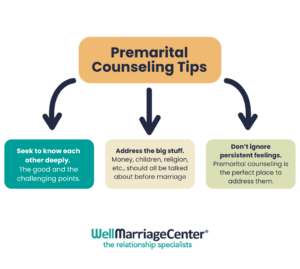
Pre-Marriage Counseling Tips

Coming to premarital counseling having done your research is a great way to start the process. You’ll have time to consider questions beforehand and know what to expect. During the actual counseling session, here are some other tips to keep in mind:

  • Seek to know each other deeply. When we’re dating someone, we have a tendency to be on our best behavior. But nobody is perfect, and everyone has flaws and weaknesses. Use premarital counseling as an opportunity to understand each other on a more meaningful level—the good and challenging parts!
  • Make sure you address the big stuff. Money, sex, children, religion, substance abuse, politics—these areas can create serious problems if you and your partner have different viewpoints. For example, if your partner is a practicing Buddhist and you’re an atheist, or you’re a recovering alcoholic and your partner drinks regularly—these are not necessarily deal breakers, but they are definitely issues that should be addressed and fleshed out before marriage.
  • Don’t ignore any nagging feelings. You may learn things about your partner you didn’t know before, and anything that bothers you now will no doubt continue to bother you as time goes on. If something new comes up and it worries you, premarital counseling is the perfect place to address it. 

Marriage Counseling and Couples Therapy

The topics addressed in marriage counseling (aka “couples therapy”) are usually a bit different than premarital counseling. Newer relationships can use premarital counseling to fully discover and understand one another, while married couples or those in a committed, long-term relationship might be past the discovery stage and looking to find their way back to one another. 

However, many of the themes in both types of counseling are the same. Both seek to address potential or present issues, overcome those challenges, and prevent them in the future. We see married and unmarried couples at Well Marriage Center looking for proactive ways to make their relationship better.

What Are Some Couples Counseling First Session Questions?

The questions and discussions topics in your first counseling session will allow your counselor to get to know you and your partner. Even as you answer these icebreaker questions, though, your counselor will be observing how you interact with one another to better inform their advice and approach in future therapy sessions.

At Well Marriage Center, all of our first sessions are extended to 90 minutes, since our counselors will need a little extra time to get to know you and your partner. In that initial session, your Well Marriage Center counselor will begin with a structured relationship strengths and wellness assessment. We like to think of it as starting on a positive note to remind you both what brought you together in the first place. The following sessions will dig progressively deeper, but that first session is a time for discovery between you and your counselor—and you and your partner.

Curious about the kinds of questions to expect during your first session? Here are a few your counselor may start with:

  • What is the story on how the two of you met
  • What initially attracted you to each other
  • What were some of your initial “admirations” of each other
  • What are 3 good times you’ve had together…and what made them good
  • In general, how would you describe your life and marriage together?
  • What does the timeline of your relationship look like? Can you tell me about major life events (new jobs, traumas, kids, etc.) from when you first met up through present day
  • What strengths do you bring to the table in your relationship? And what strengths do you think your partner has? 
  • Do you have any prior experience with marriage counseling or other types of therapy?
  • What made you decide to seek marriage counseling?
  • Have you tried anything to resolve present issues before seeking counseling? What did you try and how did that go?
  • What do you expect to get out of couples therapy?
  • Do you currently want to stay with your partner? Why or why not?
  • Are you willing to put in the work and make changes to improve the quality of your marriage?

What Do Couples Talk About in Marriage Counseling?

The good—but sometimes tough—talks can begin once you and your partner have brought your counselor up to speed. However, answering the question of “What do you talk about during marriage counseling?” is a little challenging due to the varying needs of each couple. 

Every counselor will have their own couples therapy techniques to better understand their clients and get to the root of each problem. These techniques might include answering basic questions that prompt discussion, taking turns to be active listeners, engaging in activities to reveal new things about your relationship, and more.

Ultimately, depending on which counselor you work with and the particular nature of your relationship, every discussion in couples therapy will be unique. And because each counselor will work a little differently, you might find that one counselor is a better fit over another. That’s okay! If one therapist isn’t working out, it doesn’t mean your marriage is doomed or all hope is lost. It simply means another counselor may have a different approach that works better for you and your partner. 

What Questions Are Asked in Couples Therapy?

Even though every couples therapy session will look a little different from couple to couple, there are some general questions you will likely work through as your counseling sessions progress, like:

  • What made you fall in love with your partner originally? And why do you think your partner fell in love with you? 
  • What are the biggest similarities between you and your partner? And what are the biggest differences?  
  • If you could resolve any of your relationship problems in an instant, which problem would you choose? 
  • Think about your communication with your partner when you’re experiencing different emotions—happiness, sadness, anger, fear, disappointment, etc. How does this affect your and your partner’s ability to communicate? 
  • What are some ways that you show your partner you care, love, and appreciate them? How do you feel they demonstrate this back to you?
  • What is your favorite and least favorite childhood memory? Do you know your partner’s favorite and least favorite childhood memory?
  • Do you ever find yourself lying awake at night thinking about your relationship? If so, what is the number one thing that crosses your mind?
  • How would you describe your sex life? Is there anything your partner could do to make your sexual relationship better? What have you done to improve sex in your marriage?
  • If your partner does something that bothers you, how do you address that with them? And when your partner brings up issues they may have with you, how do you handle or act on that? 
  • Does your partner treat you with the level of respect you desire? Is it the same, better, or worse than the beginning of your relationship? Why do you think that is?
  • Are there any dreams you or your partner have yet to accomplish? If so, what’s stopping you from accomplishing them?
  • Have there been any times in your relationship where you felt you could not be your genuine self? Why did you feel that way?
  • Do you and your partner enjoy any activities or shared hobbies together? Are there any that you do alone? And do you like having your own hobbies, or do you like to share them with your partner? 
  • Which topic or area do you have the most trouble opening up about with your partner? Why do you think that is? 

What Are Questions to Ask During Marriage Counseling to Your Counselor?

Therapy is always a two way street—between you and your partner, but also between you and your counselor. Don’t be afraid to ask your therapist questions before starting counseling and during your sessions. Here are some questions that you might want to consider asking your therapist at different points during your counseling journey:

  • What is your education, training, and background as a marriage counselor?
  • How many years of experience do you have, including the required supervised clinical experience you had to complete to obtain your license?
  • Are you a licensed clinical social worker, licensed marriage and family therapist, licensed professional counselor, or something else? And how does this background influence your work?
  • How many couples do you see a week? Have you made couples counseling your sole speciality?
  • Do you have any client testimonials or stories you can share with us?
  • What’s the average number of therapy sessions your successful clients go through? And how many would you recommend for us after understanding our present issues and goals?
  • Do you feel that we are making progress? Why or why not?
  • Are there additional resources you offer that we can take advantage of along with attending counseling sessions?

How Do You Have a Successful Marriage Counseling Session? Try Well Marriage Center

Trust us, we get it—relationships today face numerous hurdles, expectations, and pressures. With so much negativity weighing down on us everyday, our counselors like to take a positive, pro-relationship approach to couples therapy sessions. This means we focus on the good that you bring to your relationship, how to harness your strengths, and ultimately advocate for a successful marriage. 

With this approach, we have found our clients spend less time in therapy and can more effectively navigate relationship challenges. Our experienced and licensed counselors have a wide variety of techniques and marriage counseling questions to strengthen your relationship, tailoring every experience to your unique story.  

If you’re ready to take that first step, start by filling out our short intake form and setting up a consultation with our Intake Coordinator, Melinda. She is happy to answer any questions you may have, walk you through the process, and ensure you are connected with the best counselor for your needs. 

Is couples therapy easy? No—it takes work from both sides. But is it worth it for a happier, stronger, and healthier relationship? Absolutely. 


Average Length of Marriage Counseling

There’s no sugar-coating it—successful relationships sometimes require genuinely hard work. In some cases, adding the pressures of married life (not to mention kids, a lost job, family tragedy, and so on) to the mix can create new challenges for an otherwise healthy-enough seeming couple, or exacerbate those that already exist. The good news is that help is available in the form of marriage counseling. But how do you know if marriage counseling is really worth it? How much time and effort does the process require? And can you expect to find a better, healthier relationship on the other side, or is there a chance you’ll find yourselves just spinning your wheels without seeing real progress?

At Well Marriage Center, we understand these anxieties and want to help couples of all types to rediscover the joys of a healthy relationship. We’ve put this particular blog together to help you answer some of the most common questions we hear from couples considering counseling who want to make sure they get their money’s worth and, more importantly, improve their relationships. 

In this piece, we’ll not only answer the question of how long marriage counseling tends to take—we’ll also provide you with some pointers to ensure that if you commit to counseling you’ll have a positive and productive experience.

How Do You Know When It’s Time for Couples Counseling?

While every relationship is as unique as the two individuals themselves, it’s worth knowing the types of signs that your marriage or relationship could benefit from counseling. There are many, many factors that can create relationship problems, but here are a few of the most common, foundational signs that your relationship might be improved through counseling:

  • Communication is breaking down (or has been broken for a while): A huge subset of marriage problems center around issues related to communication. When couples lose the ability to consistently engage in open, honest communication, it can exacerbate existing issues, create new issues, or both. A major component of marriage counseling is the re-opening of communication channels and the development of healthier communication methods. 
  • You’ve lost that loving feeling: For many couples, changes to how they demonstrate affection and cultivate intimacy can signal one or more issues. For example, perhaps one partner withholds affection or allows resentment to fester. Maybe it’s gotten to the point that one or more partners is considering infidelity as a means of fulfilling their needs for intimacy and security. Even at this stage, counseling can help repair relationships.
  • Trust has eroded: Once one partner begins to lose trust in the other—whether due to infidelity or other factors—it can become a slippery slope toward conflict and divorce. Negative feelings can quickly snowball, especially when they’re not properly explored, expressed, and worked through. In these situations, a marriage counselor can help reset the dynamic nature of a partnership, build new foundations for communication and trust, and lay the groundwork for a better, happier relationship.

When Do Most Couples Consider Marriage Counseling?

All too often, couples begin marriage counseling weeks, months, or even years after problems begin to emerge within the relationship. This is perfectly understandable, as it can be difficult to know (in the present) whether relationship issues are serious or not. It can also be difficult from an emotional standpoint to acknowledge that there are problems in the relationship. Finally, especially for those who have never experienced any form of professional counseling before, it can be an intimidating prospect. The time component can seem overwhelming, as can the anxiety of delving into deeply personal, emotional matters. This is where humanity’s well-documented “fear of the unknown” comes into play, as well. 

All of that being said, when it really comes down to it, according to the Journal of Marital and Family Therapy, most couples aren’t exactly prompt in seeking out counseling at the first signs of marital issues. In fact, most couples wait two years from the onset of a problem. That’s two years for issues to manifest even more deeply, and for the relationship to potentially become even more damaged. The good news is, there’s no time like the present to take the first step in healing the relationship by connecting with a marriage counselor. 

Should Every Couple Go To Therapy?

No, we don’t believe every couple necessarily needs therapy—but we also don’t necessarily think it could hurt. However, we understand that there’s a certain stigma around couples therapy and marriage counseling when private thoughts question whether the fact that you’re considering therapy means your relationship has failed. It doesn’t! 

Even couples—including married couples—who would say their relationship is good (if not great) could potentially benefit from the communication and trust-building strategies that come with counseling. It’s also worth noting that Well Marriage Center also offers premarital counseling, which can help couples strengthen their relationship (prior to getting married) by establishing a solid foundation for communication and openness.

Is It Appropriate To Undergo Marriage Counseling When You Want a Divorce?

It’s absolutely appropriate! Just because one or both of you might be considering divorce, it doesn’t mean the marriage is a lost cause. If both parties are open to reconciliation and willing to put in the work, marriage counseling can be a relationship-saver, especially with a pro-relationship counseling approach (like Well Marriage Center’s).

How Long Should Marriage Counseling Last?

While many variables may impact how long a specific couple spends with their marriage counselor, you can generally expect, on average, anywhere from 12 to 25 counseling sessions. These will normally start off with a discovery-based focus, with the counselor asking baseline-type questions to better understand the relationship’s strengths and weaknesses. From there, individual sessions can be more tactical, working through specific problems and developing patterns for better relationship-building.  

What Is the Average Length of Counseling Sessions, and How Frequently Do They Occur?

Counseling sessions typically last for around 50 minutes, and they’re often scheduled on a weekly basis to start and eventually move to twice a month and then just once a month. This frequency allows us to spread out the course of counseling (keeping it more affordable) and stay with you longer, anywhere from 4 to 10 months. A counselor will often work with you to determine a cadence that will fit the participants’ schedules.

What Percentage of Marriages Survive After Counseling?

If you’re one of the many people or couples asking yourself questions like “Does marriage counseling work?” and “Is marriage counseling worth it?” then this section’s for you. 

If you’re particularly results-driven, you’re probably wondering, “What percentage of marriages survive after counseling?” Fortunately, counseling does work a majority of the time. According to the American Association for Marriage and Family Therapy, 90% of counseling clients report an improvement in their emotional health after receiving treatment. More specific to the marriage counseling success rate, over 75% of marital or family therapy clients report an improvement in their relationship as a result of counseling.

What Factors Impact the Length of Counseling?

For many people considering counseling, the time component is just one piece of the puzzle. In reality, several distinct factors impact how long a particular couple may need to attend marriage counseling. Of these, one of the most important is how well the counselor and participants establish rapport and trust. When a trusting bond is established early on, individual sessions can focus on specific, relevant topics, prioritized by importance. With that in mind, then, let’s next explore a few variables related to both the counselor and the participants. 

What To Look for in a Marriage Counselor

Signs of a Good Couples Therapist

A good couples therapist or marriage counselor is an advocate for repairing and strengthening relationships (as opposed to throwing in the towel). At Well Marriage Center, our counselors practice what’s called pro-relationship marriage counseling (as opposed to marriage-neutral counseling). This means our number one goal is to help couples stay together. This approach helps alleviate some of the anxiety couples might feel toward counseling, where they fear that counseling might make the relationship worse—if not lead to divorce. You can learn more about our Wellness Model here. 

Additional signs of a good couples therapist or marriage counselor include:

  • A specialization (supported by specific training) in relationships and marriages
  • An approach that focuses on couples succeeding and staying together
  • Experience working with different types of marital problems
  • A communication style that is relatable and builds trust

Signs of a Bad Marriage Counselor

To be effective in their work, a marriage counselor needs to be able to build trust with their clients, ask probing questions, listen carefully, and get to the root of their problems. In other words, just like in a marriage, communication is key to the counselor-participant relationship. Without open communication, the possibility of positive outcomes greatly decreases. 

Additional signs of a bad, or ineffective, couples therapist or marriage counselor include:

  • An over-reliance of jargon, rather than personalized communication
  • Jumping to premature, general-type conclusions or making recommendations before hearing the whole story of each participant’s experiences
  • A lack of concrete, actionable information/perspectives
  • A lack of demonstrable progress or defined goals after multiple sessions

Ultimately, even the most highly-qualified and well-intentioned marriage counselor is going to struggle to make headway if one or more of the participants is unwilling or unable to participate constructively. To improve the chances of success, then, it’s also important that you’ve prepared your heart and mind for the difficult but important work of strengthening the relationship. 

How To Prepare for Couples Counseling

As with any type of therapy or counseling, what you bring to the process certainly impacts what you’ll get out of it. Even the best marriage counselor can’t help an individual (or couple) who is unwilling to open their heart and mind to be present and engage with the process. If even one partner closes off or becomes antagonistic, it can wreck the process (and even the marriage). So, how should you prepare for marriage counseling,  to maximize the time? Here’s a brief overview of what to know before going to couples therapy, so you can make the most of the opportunities it presents.

Get yourself mentally ready. It would be inappropriate for us to claim that marriage counseling is going to be a breeze. The truth is, an effective counselor is going to broach some difficult topics and ask some tough questions. Especially if you’ve never worked with a therapist or counselor before, this can be uncomfortable and intimidating. This is why it’s important to mentally prepare, not just for an individual session but for the overall, ongoing counseling experience as well. 

Sort out your thoughts and feelings. For many married couples who take the step to work with a marriage counselor, it can feel overwhelming to get your thoughts together. It’s also very normal for participants to think about their relationship outside the confines of their counseling sessions. To ensure that nothing too important slips through the cracks, a counselor might recommend personal journaling throughout the week, so you can come to the next session with specific things you want to ask or talk about, new insights or revelations, and so on.

Familiarize yourself with the counselor’s approach. As you start to learn more about your counselor’s general approach, you can better anticipate what to expect in future sessions. This should not only reduce anxiety, but help make the most of your time with the therapist or counselor as well.

Have realistic expectations. Nothing is necessarily guaranteed in this life, so while we want clients to be optimistic about counseling outcomes, we also know it’s best for you to expect growth and improvement, not an immediate, 180-degree turnaround. This is especially true for ongoing, persistent issues. It can be difficult work, but it can also be truly transformative. At Well Marriage Center, we’ve seen couples who thought all hope was lost find their way back to one another.

Don’t be afraid to ask questions. All too often, marriage counseling participants feel like the counselor is the one who should be asking all the questions. This simply isn’t the case. While you obviously shouldn’t interrupt the counselor or disrupt the flow of the conversation with random questions that cross your mind, you should certainly ask any questions that might help you to better engage with and understand the counseling approach.

When your partner shares, keep an open mind/heart—and assume positive intent. Just as important as it is to begin the counseling process with an open mind, you should also make sure to assume the best possible intention(s) of your partner and counselor, too. This means, for example, taking your partner’s contributions at face value—assuming that they, like you, are there to put in the work and save the marriage.

What Makes Well Marriage Center’s Pro-Relationship  Counseling Work So Well?

At Well Marriage Center, we provide a strengths-based, pro-relationship approach to counseling. This means getting to know our clients and their relationships, exploring root issues, developing effective communication, and providing personalized counseling recommendations. 

It all begins with the understanding that no two couples are the same. That’s why our process builds its foundation on a relationship’s strengths and works to develop those strengths into better, healthier relationships. Here’s how our process works:

  • First, you’ll schedule an initial appointment with one of our counselors. Rather than asking vague questions like “What seems to be the problem today?”, we instead start with a structured assessment to identify strengths and weaknesses in the relationship. This, then, provides the foundation for further sessions, in which identified strengths can be further developed into the fabric of the relationship.
  • Next, our team will create a customized plan around your goals. Leveraging our experience working with over 12,000 couples, we focus on relationship science. Based on what’s working in the relationship—and what you want to improve—we’re uniquely trained to adjust and improve the course of counseling as needed.
  • Finally, we’ll work together to establish specific relationship objectives and develop an action plan. This might mean identifying and then working through how to interrupt toxic cycles a relationship might be stuck in, or remedy an uneven dynamic. Or, it might mean recapturing—and then maintaining—the relationship’s original spark. It could also mean digging deeply into specific traumas that might be impacting the quality of the relationship. 

If you’re ready to start the process of finding your way back to each other, the first step’s easy. You’ll simply need to fill out our short Intake Form, and then set up an appointment with Melinda, our Intake Coordinator. She’ll help to answer any questions you have and connect you with a therapist in your area who is available to work with you.  


How Long Does Marriage Counseling Take?

How much time would you be willing to spend a week to get a happier, healthier, more enriching relationship with your spouse or partner? Marriage counseling sessions typically take around 50 minutes per session, with the  average length of marriage counseling  totaling 12-25 conversations over the course of a few months. The return on this time can be transformative and Well Marriage Center is here to answer all your questions about the timing and length of marriage counseling. Here’s what you need to know!

But First…Couples Therapy vs Marriage Counseling

Before we dig into how long marriage counseling takes, we want to clarify that we do not see a difference between couples therapy and marriage counseling. We create a safe space for every relationship to be built, healed, or restored, regardless of if there is a legal marriage or a different style of commitment. Whether you call it marriage counseling, couples therapy, or some other combination of terms, the goals of reducing conflict, restoring intimacy and trust, and developing better communication are the same. Whatever type of committed relationship you are in, our team has dedicated their careers to helping couples build a better foundation for the future. 

When To Go To Couples Therapy

When a relationship is already going through challenges, setting aside time each week for couples therapy can feel like a big ask. Often, couples choose to look in the other direction and hope the phase will pass instead of seeking targeted help for long-term problems. When these issues reach a breaking point,  often the best option is couples therapy. In fact, if you’re thinking you might need therapy, it might be time to schedule an initial session. But when should you put it on the calendar? It’s important to choose a time that can regularly work for you, your partner, and your mutual schedules. If you can schedule a recurring appointment for the same time and weekday, then nurturing your relationship starts to become a healthy part of your routine more naturally. 

How Often Should You Go To Couples Therapy?

At Well Marriage Center, we recommend our couples start with weekly therapy sessions. This allows participants to start forming better habits and addressing issues in an environment of supportive accountability. After the first few sessions have laid a foundation for progress and determined your end goals as a couple, you may agree to start meeting bi-monthly, and eventually once a month or even less. This gradual decline in the number of sessions you need to attend is supported by better daily experiences in the relationship as the lessons from therapy take root and help you grow together in the right direction. However, every couple is different. Some may decide to further benefit from prolonged therapy  to truly heal and resolve relationship traumas. You should go to couples therapy for as long as it feels supportive and beneficial towards your relationship goals. 

How Long Does Couples Therapy Take To Work?

Couples generally attend between 12-25 sessions of therapy before they arrive at a place where they are satisfied with their growth. However, that doesn’t mean it takes 12 sessions for therapy to show any results. Week to week, you and your partner will be following techniques and activities in your daily life to reinforce what you have discussed with your therapist. As you grow and get more in tune through doing the work, the benefits will show up along the journey.

You’ll focus on identifying and honoring the strengths that still exist within your relationship, as well as set goals for communication, conflict resolution, and moving forward. Through these techniques, therapy can begin to reset negative or toxic patterns in your relationship from the first session onward. For some couples, these small, foundational changes may take longer to emerge because every relationship is unique. You can always talk to your therapist about your goals and timelines during a session. 

Some couples are concerned about how long marriage counseling takes to work in specific situations, like at the beginning of a marriage or when it is at risk of ending. Here are some more specific answers to common questions. 

Should You Go To Couples Therapy Before Marriage?

Investing in a pre-marriage therapy program is an excellent way to get your married life off to a strong start. Even though marriage is an exciting time of hope and planning for the future, it can also feel uncertain, overwhelming, and even confusing based on past events in the relationship. During our pre-marital program, you will meet with a Well Marriage Center therapist for as many sessions as you agree on. These conversations will be dedicated to your personal histories and dating story, any current concerns about the relationship, and the goals and plans you have set for the future. 

One thing that makes our pre-marital program unique is that we meet twice again after you are married, once around the six-month point and once around your one-year anniversary. This establishes a few neutral touchpoints for you and your new spouse to check in around goals and discuss anything new that has arisen after the knot is tied. 

Does Marriage Counseling Work After Separation

Yes, marriage counseling can work for both the couple and an individual after separation. It depends on the goals you have moving forward from the separation. If you want to reconcile and heal the relationship, marriage counseling provides a neutral opportunity to talk about what has gone wrong in the short-term and how it has impacted the long-term relationship. At Well Marriage Center, we practice pro-relationship counseling, seeking to heal and restore your relationship along with you even when you aren’t sure it’s possible. On the other hand, there might be no way to reconcile, but one or both parties need support adjusting to life outside of marriage. A licensed marriage counselor can also help with this, empowering you to figure out what went wrong in the relationship and help you avoid repeating similar issues in the future. Whether you want to fix the separation or heal yourself on the other side, marriage counseling can help. 

Well Marriage Center Helps You Keep Healing

The relationship specialists at Well Marriage Center are committed to helping you restore your relationship with each session you invest. They’ve dedicated their entire careers to helping couples just like you, whether you hope to be done with marriage counseling in just 12 sessions, or you think 25 doesn’t sound like enough. The good news is that you and your partner set the pace and get to have input about how many sessions you think you need. Whether we see you every week or once a month, we want you to leave each meeting feeling like you achieved something together and know what to work on next. That’s how healing happens–one day at a time, slowly but surely. We’re here to stick with you throughout the journey! Set up a conversation with our Intake Coordinator, Melinda, to share a little bit about where your relationship is at and where you want to go.