Posts

Marriage Counseling: What Not To Say

Beginning marriage counseling means you are committed to doing hard work to restore your relationship. That work includes speaking your truth about hopes, fears, hurts, and happiness. Reigniting joy in your relationship requires clearing some debris along with rekindling the spark. Counseling is meant to be a safe space where you can express your needs and frustrations. But bringing trauma and challenges to the table means you and/or your partner might already be walking on eggshells trying to avoid making things worse. You might be so afraid of saying the wrong thing that you don’t want to say anything at all.

Are there things you should not tell the therapist, but wait to discuss with your partner in private? Are there things you should keep to yourself and not tell anyone for the sake of getting along? Will your honest answers to the marriage counseling session questions do more harm than good? These questions and others might be circling in your brain, losing you sleep, and increasing your anxiety as the appointment date gets closer and closer. 

Pause. 

It’s totally natural and healthy to feel these concerns and generally be nervous about the first marriage counseling session. Now, take a breath. Well Marriage Center has put together this guide to help you prepare for the journey ahead. After reading this, you will be better-equipped to balance your statements in the moment with your long-term goals for the relationship. We want to support you in making your own best judgments about what to say to both the therapist and your partner, when to say it so it can be constructive, and how to say it with love. 

What Do You Talk About in Marriage Counseling?

When you start marriage counseling, what to expect can be a little confusing. You might worry that the main topic of discussion during marriage counseling will be all your problems and everything negative that has happened in your relationship so far. If you are working with a less-experienced counselor or a therapist who does not specialize in couples therapy, they might even mistakenly guide you in this direction. But only talking about the problems is itself a problem. While you can’t address and move past your issues without talking about them, you should also talk about positives. 

At Well Marriage Center, we employ a strengths-based approach, taking the time to learn what you admire about one another, what drew you together, and what has kept you together despite difficulties. Our counselors respect your desire to preserve and strengthen your relationship, and work to heal and restore the connection between you and your partner. 

One of the biggest signs of a good couples therapist is that they do not take a one-size-fits-all approach to their work. What you talk about will depend on what brought you into counseling to begin with. And whatever the subject of discussion, you deserve a therapist who is as committed to fighting to protect your relationship as you are. What Statements Cause Problems With Couples Therapy?

There are statements from both the participants and the therapist that can cause problems with couples therapy. Let’s start with some of the things you should not say.

  1. “It’s your fault…”

There are many issues and challenges that bring couples to therapy, and some come with blame from one or both sides. Infidelity, lack of intimacy, disconnection…both parties in the relationship might tell a different story about why these situations have come to pass. In each of these scenarios and others, the initial fault or bad action might even lie with one partner over the other. But part of the work of therapy is understanding the broader dynamics of your relationship. Once a couple works past the need to place blame, they can release bitterness and begin to heal. Though it may sound scary to put a pause on blame, this is a liberating experience that can effectively reveal more strength in your relationship. All in all, continuing to focus on the faults of the past keeps you trapped in the old relationship that you are trying to repair and restore into something better than ever. 

     2. “Don’t tell my spouse/partner…”

It’s important to understand you should not expect your therapist to take sides. Asking your therapist to keep something a secret from your partner or spouse is a request which can actively hold back your healing. If there is something you do not want your partner to know, but you do want the counselor to know, it’s important to explore why that is. What are you worried might happen if this secret becomes known in the relationship? Talking through what you want to keep hidden in the safe space of therapy can help you and your spouse deal with the emotional pain, questions, and/or fears that are driving your hesitation. 

In some cases, it might still be a good idea to talk with your therapist individually about big reveals you would like to make. Past infidelity that is not known to your partner, hidden feelings and experiences–these can require planning to make known, and it might be the opinion of your therapist that more healing is needed before certain things come out. It’s not to say that a therapist will keep your secret, but they can help you plan bringing it to light in a positive way that does not further damage your relationship.

     3. “I want a divorce/breakup.”

Since marriage counseling is a safe space to express your feelings, you might wonder why this statement is something you should not say. Ultimately, if you do want a divorce, or a breakup for those who are in couples therapy while dating, then this might already be known to the spouses and counselor. But continuing to repeat it reflects that therapy may not be working. 

More often, we find that when this statement is made during a counseling session, it is a threat coming from a place of deep distress and frustration. While you might later decide you did not mean this statement, your partner will remember what you said and might even take you seriously. Your marriage counselor is on your side to help solve and work through negative feelings within the relationship to preserve the good while healing the bad. Threatening to end the relationship in the middle of counseling is expressly working against this effort. 

There are also some things your therapist should not say. Your therapist should never be the one to tell you that your relationship needs to end. They should also never say anything that makes you feel judged,, belittled, or otherwise unsupported. At Well Marriage Center, we practice pro-relationship counseling, listening to your specific mutual needs, goals, and concerns to tailor an approach that can help you and your partner find your way back to each other.

How To Handle Feeling Attacked in Couples Therapy

Feeling criticized is one of the four main predictors of relationship unhappiness, according to Dr. John Gottman, a foundational researcher in the field of relationships. Dr. Gottman also researched defensiveness that emerges when we feel attacked. When you speak up to defend yourself against the perceived attack, your partner then speaks up in defense of their initial criticism, trapping you each in your own perspectives trying to prove you are innocent. Luckily, in addition to describing these dynamics with his research, Dr. Gottman also came up with an Antidote to Defensiveness:

  1. Seek the truth within the criticism. When criticism is given, it’s because your partner has something important they are trying to tell you. What is that?
  2. Give the benefit of the doubt. Your partner is not trying to make you feel bad about yourself. In fact, the criticism might be more about what they are feeling than what you did or did not do. 
  3. Validate your partner’s perception, even if you do not agree. Telling them they are wrong or becoming argumentative/defensive is only going to deepen the rift in the relationship. You don’t have to agree with their perspective, but you do have to accept that it exists. 
  4. Tell your partner what you can agree with. Are they right about a way you behaved, an outcome that occurred, or something that could have gone differently? Repeating back something they said lets them know you were listening. 
  5. Bring up your difference of opinion. Of course, your feelings are equally valid and deserve to be equally heard. Leaving this part until last allows you time to process and avoid having too extreme of a reaction based on your defensive feelings.

Depending on the circumstances which have brought you to this point, it may be very difficult to validate your partner’s perception and accept the truth within criticism. Remember that when your partner is speaking, you should be listening to understand their perspective, not already planning what you will say in response. That work is exactly what experts like the therapists at Well Marriage Center are here to help you do!

How To Prepare for Marriage Counseling

As you get ready for marriage counseling, questions to strengthen your relationship and topics for conversation might be top of mind. Or you might be anxious about telling your side of the story or hearing your partner’s. Remember going in that it’s important to find the foundation in the strengths of the relationship. If the goal is to try to stay together, be ready to start by exploring why that is. Preparing for marriage counseling means preparing to welcome gratitude, respect, passion, and compassion back into your relationship. It won’t happen with the first session, but we have seen it happen for many couples. 

Contact Well Marriage Center for Effective Marriage Counseling

There are many factors that impact whether a certain marriage counselor is right for each couple. Well Marriage Center may not be right for everyone, but with a diverse group of specialists we do believe we can lend perspective to a tense, lonely relationship. We have 21 offices across the US, so it’s possible we might already be in your area or be delivering telehealth marriage counseling in your state. 

Our counselors study many different methods and schools of thought to deliver unique approaches that are tailored for each relationship. Sometimes the strengths-based model reminds a couple immediately why they continue to choose each other. When working through deeper trauma or infidelity, coping with the recent events might require strengths to be explored as they are revealed through the healing process. Whatever pace of treatment and specific tuning your relationship needs, Well Marriage Center is your partner on the journey to a fresh start. Our intake coordinator Melinda can work with you to answer any questions, learn more about what your needs are and match you with a therapist. Fill out this short intake form to get some time on the calendar and get started!


 

What Are Common Goals In Couples Therapy?

The idea of going to marriage counseling can feel like the first domino falling for a failing relationship, but this is a tired and untrue sentiment associated with the practice. Deciding that therapy is the right move for the health of your relationship is one of the best actions you can take as a couple. Our team at Well Marriage Center puts our all into helping couples establish healthy practices they can implement every day so that you can find your way back to one another. 

Every couple we see is unique. Some come in with goals and a plan to attack the hurdles in their relationship, and others feel that something is off but want a professional to talk with. Whether you are in one of these camps or another altogether, there is hope for your unique relationship. Our aim with this blog is to cover the more common goals related to couples counseling so you can go to your sessions with confidence and a plan of action. 

What Is The Most Common Problem Addressed In Couples Therapy?

There is not a single problem that comes up more often than others. Normally, we see a combination of elements that has led a couple to our offices:

  • Communication Issues
  • Emotional Disconnect
  • Affairs & Infidelity
  • Intimacy Issues
  • Significant Life Events
  • Overcoming & Processing Trauma

What Are Examples Of Goals For Therapy?

Therapy goals help outline each session and create a structured path towards a happy relationship. Here are several examples our therapists see that can lead to successful results. 

  • Identify the Root Cause of the Problem: Couples may come to our office for one major issue or a host of irritations, but there is usually more under the surface that has led them to this point. Finding the root of an issue will shed light on all the related topics that both parties need to address. For example, you may be frustrated that your partner never plans anything for both of you to do. But perhaps at the root, you find there is an imbalance of relationship responsibilities that neither of you has addressed head-on. 
  • Better Understand Your Partner’s Perspective: Everyone has a lot going on in their life, and it is easy to lose sight of one another. Therapy creates an environment where both of you sit and hear each other honestly. A past situation that seemed trivial to you could have had a profound emotional impact on your partner, turning a molehill into a mountain. Coming to counseling to understand each other more deeply is a fundamental goal that is a great indicator of success. 
  • Enhance Intimacy: Intimacy is vital, as we thrive on close personal relationships with one another. However, intimacy is often solely thought of as a sexual relationship between two people. Couples counseling will expose you to other types of intimacy, such as experiential, emotional, and intellectual intimacy. Couples can have great sexual intimacy, but if the other types are not being met, your relationship could lack key elements of trust and vulnerability.
  • Achieve Better Communication: It is not uncommon for someone to feel blindsided by couples therapy. In some cases, one party may be ignoring important issues and feel that the relationship is fine. This lack of communication is something consistent sessions can fix over time. Keeping what is bothering you bottled up will lead to festering resentment towards your partner. Therapy can teach you healthy and straightforward communication methods that help avoid meaningless arguments. 

Is It Normal For Unmarried Couples To Go To Counseling?

It is absolutely normal for unmarried couples to go to counseling. Regardless of your marital status, holding off on discussing issues can lead to other, more significant problems. This is only one of the many stigmas around couples counseling that we are working to do away with here at Well Marriage Center. Additionally, we believe that heading into couples therapy even before problems arise can help you build a foundation that lasts.

Practicing healthy communication through therapy at any stage in a relationship enables couples to be better equipped when challenges do arise. Think of it like this—couples therapy is like taking care of your body by going to the gym. You don’t start going after you pull a muscle or break a bone. You go before problems start to appear to ensure that you are capable of surviving, healing, and then moving on.

What Is The Best Therapy For Relationship Problems? 

There are many different forms of couples therapy that counselors will attempt to implement to fix complex relationship issues. Some counselors will keep divorce on the table early on as an option for the couple. That is not how our team sees a successful change for a couple. Well Marriage Center believes that couples enter counseling because they want to get their relationship back to a point where respect, love, and affection are front and center. The best way to achieve this is through what we call pro-relationship counseling. A pro-relationship counselor always advocates for saving, healing, and restoring your relationship. Our team uses clinically proven methods and is committed to avoiding divorce or separation whenever possible.

Well Marriage Center: Where Happily Ever After Begins

Your relationship is special, which is why we refrain from cookie-cutter questions like “what seems to be the problem?” Over our 30+ years of experience with over 15,000 couples, we’ve repeatedly seen our pro-relationship and strengths-based approach work. When we meet with a couple, we start with an extended session (90 minutes) and begin our time with a structured relationship strength-and-wellness assessment. Our counselors are committed to helping you build a brighter relationship future. 

Get started here to put the spark back in your relationship. 


50 Marriage Counseling Questions for Before and During Marriage

Marriage counseling—to some, it indicates failure. To others, it’s a sign of hope. And to many, it’s new and unknown territory, one that might have you Googling “marriage counseling tips” or “ground rules for couples therapy” on your phone in the middle of the night. 

At Well Marriage Center, we’re all about debunking couples therapy myths and showing people the very possible and positive outcomes that can result from counseling. This is why we love answering questions like, “How can marriage counseling help a couple improve their relationship?” and “What can we expect during couples therapy?” Clients who ask these kinds of questions and who are willing to work through issues are usually the ones who find the most success from relationship counseling. 

With that in mind, we’ve put together 50 of our favorite counseling questions for the different stages of a relationship. We hope this will help you feel a bit more comfortable and prepared for the journey. Plus, we’ll give you a few tips to make the most of each therapy session. 

Premarital Counseling

Premarital (aka “pre-marriage”) counseling is an excellent way to embark on the adventure of marriage with your partner. Even if your relationship has gone relatively smoothly so far, time and the pressures of married life can introduce new and unforeseen issues. 

Those who are new to the concept of premarital counseling might wonder—does it actually work? Will it create more problems instead of solving potential issues? Many scholars, psychologists, social workers, and beyond have asked these same questions, and there are plenty of studies demonstrating the positive effects of premarital counseling. 

For example, one clinical research study entitled “Marital Satisfaction: The Impact of Premarital and Couples Counseling” found that “participants who had taken part in premarital counseling do show a trend toward high marital satisfaction.”

Another study, “Using What Premarital Couples Already Know to Inform Marriage Education” found that, “…marriage education may assist in the couples’ identification of factors that enhance and hinder their relationship. Furthermore, couples may be able to apply this knowledge to make lasting changes in their relationships.”

So we ask you—why not try it? Why not start your marriage off with the tools to enhance your relationship? Why not identify possible roadblocks and ways to overcome them? Any married couple will tell you marriage isn’t easy, but it can be an easier, happier, and more fulfilling experience through premarital counseling. 

What Kind of Questions Are Asked in Pre-Marriage Counseling?

To get started with our 50 relationship counseling questions, let’s check out some of the more common pre-marriage counseling questions for couples we like to ask at Well Marriage Center:

  • When you are about to see your partner, what thoughts and feelings go through your mind?
  • If you had to name your partner’s top three dreams or aspirations, what would they be?
  • How important is wealth to you, and how do you feel about debt?
  • What are your plans for financing large purchases, such as a house, cars, or your children’s college education? 
  • How do you plan to budget and organize your money? For example, will you keep separate or joint accounts?
  • Do you have any retirement plans currently in place? And how are you planning for retirement together as a couple?
  • What rituals do you currently have, like date nights, daily routines, weekend getaways, or vacations? And how have you shared these rituals with one another? 
  • How do you currently celebrate special occasions now, like anniversaries or holidays? And how would you like to blend or take part in those traditions together? For example, if your extended families live far apart, how will you choose where to spend time for major holidays?
  • How do you plan to sustain intimacy throughout your relationships? 
  • How would you describe your sexual needs and desires, and are there specific ways you’d like your partner to meet those needs?
  • Are you both on the same page when it comes to having children? If you want children, how many would you like to have? If infertility is an issue, how do you plan to address that?
  • What is your sense of humor like? Does your partner experience humor in the same way?
  • How do you plan to divide household chores?
  • Do you both have the same values or religious beliefs? If not, how do you plan to navigate those differences?
  • What does “infidelity” or “cheating” mean to you, and what are your fears or expectations about this in your relationship? 

premarital-program-couples-therapy

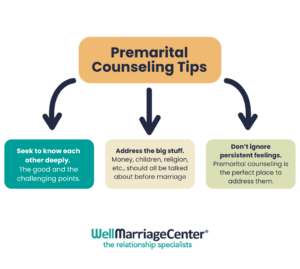
Pre-Marriage Counseling Tips

Coming to premarital counseling having done your research is a great way to start the process. You’ll have time to consider questions beforehand and know what to expect. During the actual counseling session, here are some other tips to keep in mind:

  • Seek to know each other deeply. When we’re dating someone, we have a tendency to be on our best behavior. But nobody is perfect, and everyone has flaws and weaknesses. Use premarital counseling as an opportunity to understand each other on a more meaningful level—the good and challenging parts!
  • Make sure you address the big stuff. Money, sex, children, religion, substance abuse, politics—these areas can create serious problems if you and your partner have different viewpoints. For example, if your partner is a practicing Buddhist and you’re an atheist, or you’re a recovering alcoholic and your partner drinks regularly—these are not necessarily deal breakers, but they are definitely issues that should be addressed and fleshed out before marriage.
  • Don’t ignore any nagging feelings. You may learn things about your partner you didn’t know before, and anything that bothers you now will no doubt continue to bother you as time goes on. If something new comes up and it worries you, premarital counseling is the perfect place to address it. 

Marriage Counseling and Couples Therapy

The topics addressed in marriage counseling (aka “couples therapy”) are usually a bit different than premarital counseling. Newer relationships can use premarital counseling to fully discover and understand one another, while married couples or those in a committed, long-term relationship might be past the discovery stage and looking to find their way back to one another. 

However, many of the themes in both types of counseling are the same. Both seek to address potential or present issues, overcome those challenges, and prevent them in the future. We see married and unmarried couples at Well Marriage Center looking for proactive ways to make their relationship better.

What Are Some Couples Counseling First Session Questions?

The questions and discussions topics in your first counseling session will allow your counselor to get to know you and your partner. Even as you answer these icebreaker questions, though, your counselor will be observing how you interact with one another to better inform their advice and approach in future therapy sessions.

At Well Marriage Center, all of our first sessions are extended to 90 minutes, since our counselors will need a little extra time to get to know you and your partner. In that initial session, your Well Marriage Center counselor will begin with a structured relationship strengths and wellness assessment. We like to think of it as starting on a positive note to remind you both what brought you together in the first place. The following sessions will dig progressively deeper, but that first session is a time for discovery between you and your counselor—and you and your partner.

Curious about the kinds of questions to expect during your first session? Here are a few your counselor may start with:

  • What is the story on how the two of you met
  • What initially attracted you to each other
  • What were some of your initial “admirations” of each other
  • What are 3 good times you’ve had together…and what made them good
  • In general, how would you describe your life and marriage together?
  • What does the timeline of your relationship look like? Can you tell me about major life events (new jobs, traumas, kids, etc.) from when you first met up through present day
  • What strengths do you bring to the table in your relationship? And what strengths do you think your partner has? 
  • Do you have any prior experience with marriage counseling or other types of therapy?
  • What made you decide to seek marriage counseling?
  • Have you tried anything to resolve present issues before seeking counseling? What did you try and how did that go?
  • What do you expect to get out of couples therapy?
  • Do you currently want to stay with your partner? Why or why not?
  • Are you willing to put in the work and make changes to improve the quality of your marriage?

What Do Couples Talk About in Marriage Counseling?

The good—but sometimes tough—talks can begin once you and your partner have brought your counselor up to speed. However, answering the question of “What do you talk about during marriage counseling?” is a little challenging due to the varying needs of each couple. 

Every counselor will have their own couples therapy techniques to better understand their clients and get to the root of each problem. These techniques might include answering basic questions that prompt discussion, taking turns to be active listeners, engaging in activities to reveal new things about your relationship, and more.

Ultimately, depending on which counselor you work with and the particular nature of your relationship, every discussion in couples therapy will be unique. And because each counselor will work a little differently, you might find that one counselor is a better fit over another. That’s okay! If one therapist isn’t working out, it doesn’t mean your marriage is doomed or all hope is lost. It simply means another counselor may have a different approach that works better for you and your partner. 

What Questions Are Asked in Couples Therapy?

Even though every couples therapy session will look a little different from couple to couple, there are some general questions you will likely work through as your counseling sessions progress, like:

  • What made you fall in love with your partner originally? And why do you think your partner fell in love with you? 
  • What are the biggest similarities between you and your partner? And what are the biggest differences?  
  • If you could resolve any of your relationship problems in an instant, which problem would you choose? 
  • Think about your communication with your partner when you’re experiencing different emotions—happiness, sadness, anger, fear, disappointment, etc. How does this affect your and your partner’s ability to communicate? 
  • What are some ways that you show your partner you care, love, and appreciate them? How do you feel they demonstrate this back to you?
  • What is your favorite and least favorite childhood memory? Do you know your partner’s favorite and least favorite childhood memory?
  • Do you ever find yourself lying awake at night thinking about your relationship? If so, what is the number one thing that crosses your mind?
  • How would you describe your sex life? Is there anything your partner could do to make your sexual relationship better? What have you done to improve sex in your marriage?
  • If your partner does something that bothers you, how do you address that with them? And when your partner brings up issues they may have with you, how do you handle or act on that? 
  • Does your partner treat you with the level of respect you desire? Is it the same, better, or worse than the beginning of your relationship? Why do you think that is?
  • Are there any dreams you or your partner have yet to accomplish? If so, what’s stopping you from accomplishing them?
  • Have there been any times in your relationship where you felt you could not be your genuine self? Why did you feel that way?
  • Do you and your partner enjoy any activities or shared hobbies together? Are there any that you do alone? And do you like having your own hobbies, or do you like to share them with your partner? 
  • Which topic or area do you have the most trouble opening up about with your partner? Why do you think that is? 

What Are Questions to Ask During Marriage Counseling to Your Counselor?

Therapy is always a two way street—between you and your partner, but also between you and your counselor. Don’t be afraid to ask your therapist questions before starting counseling and during your sessions. Here are some questions that you might want to consider asking your therapist at different points during your counseling journey:

  • What is your education, training, and background as a marriage counselor?
  • How many years of experience do you have, including the required supervised clinical experience you had to complete to obtain your license?
  • Are you a licensed clinical social worker, licensed marriage and family therapist, licensed professional counselor, or something else? And how does this background influence your work?
  • How many couples do you see a week? Have you made couples counseling your sole speciality?
  • Do you have any client testimonials or stories you can share with us?
  • What’s the average number of therapy sessions your successful clients go through? And how many would you recommend for us after understanding our present issues and goals?
  • Do you feel that we are making progress? Why or why not?
  • Are there additional resources you offer that we can take advantage of along with attending counseling sessions?

How Do You Have a Successful Marriage Counseling Session? Try Well Marriage Center

Trust us, we get it—relationships today face numerous hurdles, expectations, and pressures. With so much negativity weighing down on us everyday, our counselors like to take a positive, pro-relationship approach to couples therapy sessions. This means we focus on the good that you bring to your relationship, how to harness your strengths, and ultimately advocate for a successful marriage. 

With this approach, we have found our clients spend less time in therapy and can more effectively navigate relationship challenges. Our experienced and licensed counselors have a wide variety of techniques and marriage counseling questions to strengthen your relationship, tailoring every experience to your unique story.  

If you’re ready to take that first step, start by filling out our short intake form and setting up a consultation with our Intake Coordinator, Melinda. She is happy to answer any questions you may have, walk you through the process, and ensure you are connected with the best counselor for your needs. 

Is couples therapy easy? No—it takes work from both sides. But is it worth it for a happier, stronger, and healthier relationship? Absolutely. 


How Long Is Too Long for Couples Therapy?

It can be intimidating and scary to join the 49% of couples who attend marriage counseling (or to be part of the 52% who are interested in trying it). Whether you’re currently going to sessions or considering starting, you may be wondering how long this process will take. What’s the average length of marriage counseling? Can you stay in couples therapy too long? 

Don’t worry! All your questions will be answered. From our experience working with over 15,000 couples here at Well Marriage Center, we know that the topic of couples counseling can be sensitive, especially when the stakes feel so high. Let’s get started with some of the most common questions about couples counseling. 

Note: At Well Marriage Center, we use the terms “marriage counseling,” “couples counseling,” and “couples therapy” interchangeably, and we offer our services to any couple—regardless of their marital status. The term “marriage” can be exclusionary or uncomfortable, and we aim to provide an environment that’s welcoming to all couples. What matters most is you, your relationship, and your desire to rediscover joy with your partner.

How Long Do Couples Usually Go to Therapy?

In general, the average length of couples therapy that we see at Well Marriage Center is 12-25 sessions. This takes place over the course of 4 to 10 months. However, the specific number of how many marriage counseling sessions are needed will be determined by your therapist, your unique relationship, and how you and your partner are progressing. Each individual session is typically around the 50 minute mark, although this will vary depending on your therapist.

How Long Is Too Long for Marriage Counseling?

There really isn’t an exact answer to this question because every relationship is different, and every marriage counseling provider has a different approach based on each couple’s unique needs. It’s also important to keep the end goal in mind: a healthy, thriving relationship. Couples therapy is typically designed to be a shorter-term commitment, as opposed to individual therapy, which many people benefit from attending for years. If you’re worried about  couples therapy dragging on forever, be sure to ask your provider about the timeline. 

If you’re feeling like you have been in couples therapy for too long, be sure to consider if you have met your end goal. Have you and your partner learned and implemented communication skills? Are there any unresolved trust or commitment issues lingering? Have you addressed the problems that brought you to couples counseling in the first place? Has your therapist given any guidelines or suggested a potential end goal?

If you and your partner are confident that you have met your end goal, then it’s definitely appropriate to have a conversation with your counselor about wrapping up your sessions. However, if there is still work to be done, then you may want to consider trying a different approach or provider. 

How Long To Try Marriage Counseling Before Divorce

Here at Well Marriage, our focus is on helping couples find their way back to each other. When you’re in the midst of a relationship with serious challenges, we know it can feel overwhelming or even impossible to heal and restore things. But rest assured—there is hope! Our counselors practice pro-relationship counseling, an approach that prioritizes the revitalization of your relationship. We’ve seen so many couples who are convinced they are on the road to splitting up realize through the process of couples therapy that their journey together isn’t over yet. 

When To Stop Marriage Counseling

No matter if you call it “marriage counseling” or “couples therapy,” the fact is that your sessions are not going to last forever. There will come a point where you and your partner have learned how to communicate better and are building a healthy relationship together. In general, look for signs that marriage counseling is working

  • You and your partner don’t have as much conflict
  • You have great communication strategies in place (and are practicing them!)
  • You’ve settled on realistic solutions to issues
  • Your relationship is happier and healthier

Your goals will vary, of course, and it’s also a fantastic idea to talk with your counselor about when to stop marriage counseling. After all, they want the same thing that you do—a thriving relationship. The goal of couples therapy isn’t to stay in couples therapy forever, so it’s completely appropriate to ask your therapist about the process and what signals they look for. 

Is It Worth Going to Couples Therapy?

Absolutely! In fact, we think it’s one of the most beneficial steps you can take for your relationship. We believe that almost every relationship can be transformed into a vibrant partnership, as long as both people are willing to put in the work. 

Often people ask things like, “can couples therapy save my relationship?” It’s important to remember that there are so many variables involved, and every relationship will be different. Because of this, it’s difficult to properly assess the effectiveness of couples therapy and impossible to answer this question with a direct yes or no. However, one study found that going through couples counseling can improve outcomes for couples, like relationship satisfaction, communication skills, and general well-being. 

Well Marriage: Couples Therapy Customized for You

Through our experiences at Well Marriage Center, we’ve seen incredible results time after time. We specialize in couples and use a variety of techniques to meet the needs of each unique relationship. Our counselors use empirically-backed approaches and interventions like:

  • Dr. Ellyn Bader – Developmental Model of Couples Therapy (our personal favorite)
  • Dr. John Gottman – Gottman Institute
  • Dr. Sue Johnson – Emotionally Focused Therapy (EFT)
  • Dr. Harville Hendrix – Imago Therapy
  • Dr. Esther Perel – Eroticism and Desire
  • Dr. Terry Real – Relational Life Institute

We’ll work closely with you to make sure that your couples therapy is the right length and uses techniques that are fitted to your relationship goals and challenges.  If you’re interested in learning more, we invite you to privately explore our website and learn more about what we offer, where we’re located, and what our services cost

Average Length of Marriage Counseling

There’s no sugar-coating it—successful relationships sometimes require genuinely hard work. In some cases, adding the pressures of married life (not to mention kids, a lost job, family tragedy, and so on) to the mix can create new challenges for an otherwise healthy-enough seeming couple, or exacerbate those that already exist. The good news is that help is available in the form of marriage counseling. But how do you know if marriage counseling is really worth it? How much time and effort does the process require? And can you expect to find a better, healthier relationship on the other side, or is there a chance you’ll find yourselves just spinning your wheels without seeing real progress?

At Well Marriage Center, we understand these anxieties and want to help couples of all types to rediscover the joys of a healthy relationship. We’ve put this particular blog together to help you answer some of the most common questions we hear from couples considering counseling who want to make sure they get their money’s worth and, more importantly, improve their relationships. 

In this piece, we’ll not only answer the question of how long marriage counseling tends to take—we’ll also provide you with some pointers to ensure that if you commit to counseling you’ll have a positive and productive experience.

How Do You Know When It’s Time for Couples Counseling?

While every relationship is as unique as the two individuals themselves, it’s worth knowing the types of signs that your marriage or relationship could benefit from counseling. There are many, many factors that can create relationship problems, but here are a few of the most common, foundational signs that your relationship might be improved through counseling:

  • Communication is breaking down (or has been broken for a while): A huge subset of marriage problems center around issues related to communication. When couples lose the ability to consistently engage in open, honest communication, it can exacerbate existing issues, create new issues, or both. A major component of marriage counseling is the re-opening of communication channels and the development of healthier communication methods. 
  • You’ve lost that loving feeling: For many couples, changes to how they demonstrate affection and cultivate intimacy can signal one or more issues. For example, perhaps one partner withholds affection or allows resentment to fester. Maybe it’s gotten to the point that one or more partners is considering infidelity as a means of fulfilling their needs for intimacy and security. Even at this stage, counseling can help repair relationships.
  • Trust has eroded: Once one partner begins to lose trust in the other—whether due to infidelity or other factors—it can become a slippery slope toward conflict and divorce. Negative feelings can quickly snowball, especially when they’re not properly explored, expressed, and worked through. In these situations, a marriage counselor can help reset the dynamic nature of a partnership, build new foundations for communication and trust, and lay the groundwork for a better, happier relationship.

When Do Most Couples Consider Marriage Counseling?

All too often, couples begin marriage counseling weeks, months, or even years after problems begin to emerge within the relationship. This is perfectly understandable, as it can be difficult to know (in the present) whether relationship issues are serious or not. It can also be difficult from an emotional standpoint to acknowledge that there are problems in the relationship. Finally, especially for those who have never experienced any form of professional counseling before, it can be an intimidating prospect. The time component can seem overwhelming, as can the anxiety of delving into deeply personal, emotional matters. This is where humanity’s well-documented “fear of the unknown” comes into play, as well. 

All of that being said, when it really comes down to it, according to the Journal of Marital and Family Therapy, most couples aren’t exactly prompt in seeking out counseling at the first signs of marital issues. In fact, most couples wait two years from the onset of a problem. That’s two years for issues to manifest even more deeply, and for the relationship to potentially become even more damaged. The good news is, there’s no time like the present to take the first step in healing the relationship by connecting with a marriage counselor. 

Should Every Couple Go To Therapy?

No, we don’t believe every couple necessarily needs therapy—but we also don’t necessarily think it could hurt. However, we understand that there’s a certain stigma around couples therapy and marriage counseling when private thoughts question whether the fact that you’re considering therapy means your relationship has failed. It doesn’t! 

Even couples—including married couples—who would say their relationship is good (if not great) could potentially benefit from the communication and trust-building strategies that come with counseling. It’s also worth noting that Well Marriage Center also offers premarital counseling, which can help couples strengthen their relationship (prior to getting married) by establishing a solid foundation for communication and openness.

Is It Appropriate To Undergo Marriage Counseling When You Want a Divorce?

It’s absolutely appropriate! Just because one or both of you might be considering divorce, it doesn’t mean the marriage is a lost cause. If both parties are open to reconciliation and willing to put in the work, marriage counseling can be a relationship-saver, especially with a pro-relationship counseling approach (like Well Marriage Center’s).

How Long Should Marriage Counseling Last?

While many variables may impact how long a specific couple spends with their marriage counselor, you can generally expect, on average, anywhere from 12 to 25 counseling sessions. These will normally start off with a discovery-based focus, with the counselor asking baseline-type questions to better understand the relationship’s strengths and weaknesses. From there, individual sessions can be more tactical, working through specific problems and developing patterns for better relationship-building.  

What Is the Average Length of Counseling Sessions, and How Frequently Do They Occur?

Counseling sessions typically last for around 50 minutes, and they’re often scheduled on a weekly basis to start and eventually move to twice a month and then just once a month. This frequency allows us to spread out the course of counseling (keeping it more affordable) and stay with you longer, anywhere from 4 to 10 months. A counselor will often work with you to determine a cadence that will fit the participants’ schedules.

What Percentage of Marriages Survive After Counseling?

If you’re one of the many people or couples asking yourself questions like “Does marriage counseling work?” and “Is marriage counseling worth it?” then this section’s for you. 

If you’re particularly results-driven, you’re probably wondering, “What percentage of marriages survive after counseling?” Fortunately, counseling does work a majority of the time. According to the American Association for Marriage and Family Therapy, 90% of counseling clients report an improvement in their emotional health after receiving treatment. More specific to the marriage counseling success rate, over 75% of marital or family therapy clients report an improvement in their relationship as a result of counseling.

What Factors Impact the Length of Counseling?

For many people considering counseling, the time component is just one piece of the puzzle. In reality, several distinct factors impact how long a particular couple may need to attend marriage counseling. Of these, one of the most important is how well the counselor and participants establish rapport and trust. When a trusting bond is established early on, individual sessions can focus on specific, relevant topics, prioritized by importance. With that in mind, then, let’s next explore a few variables related to both the counselor and the participants. 

What To Look for in a Marriage Counselor

Signs of a Good Couples Therapist

A good couples therapist or marriage counselor is an advocate for repairing and strengthening relationships (as opposed to throwing in the towel). At Well Marriage Center, our counselors practice what’s called pro-relationship marriage counseling (as opposed to marriage-neutral counseling). This means our number one goal is to help couples stay together. This approach helps alleviate some of the anxiety couples might feel toward counseling, where they fear that counseling might make the relationship worse—if not lead to divorce. You can learn more about our Wellness Model here. 

Additional signs of a good couples therapist or marriage counselor include:

  • A specialization (supported by specific training) in relationships and marriages
  • An approach that focuses on couples succeeding and staying together
  • Experience working with different types of marital problems
  • A communication style that is relatable and builds trust

Signs of a Bad Marriage Counselor

To be effective in their work, a marriage counselor needs to be able to build trust with their clients, ask probing questions, listen carefully, and get to the root of their problems. In other words, just like in a marriage, communication is key to the counselor-participant relationship. Without open communication, the possibility of positive outcomes greatly decreases. 

Additional signs of a bad, or ineffective, couples therapist or marriage counselor include:

  • An over-reliance of jargon, rather than personalized communication
  • Jumping to premature, general-type conclusions or making recommendations before hearing the whole story of each participant’s experiences
  • A lack of concrete, actionable information/perspectives
  • A lack of demonstrable progress or defined goals after multiple sessions

Ultimately, even the most highly-qualified and well-intentioned marriage counselor is going to struggle to make headway if one or more of the participants is unwilling or unable to participate constructively. To improve the chances of success, then, it’s also important that you’ve prepared your heart and mind for the difficult but important work of strengthening the relationship. 

How To Prepare for Couples Counseling

As with any type of therapy or counseling, what you bring to the process certainly impacts what you’ll get out of it. Even the best marriage counselor can’t help an individual (or couple) who is unwilling to open their heart and mind to be present and engage with the process. If even one partner closes off or becomes antagonistic, it can wreck the process (and even the marriage). So, how should you prepare for marriage counseling,  to maximize the time? Here’s a brief overview of what to know before going to couples therapy, so you can make the most of the opportunities it presents.

Get yourself mentally ready. It would be inappropriate for us to claim that marriage counseling is going to be a breeze. The truth is, an effective counselor is going to broach some difficult topics and ask some tough questions. Especially if you’ve never worked with a therapist or counselor before, this can be uncomfortable and intimidating. This is why it’s important to mentally prepare, not just for an individual session but for the overall, ongoing counseling experience as well. 

Sort out your thoughts and feelings. For many married couples who take the step to work with a marriage counselor, it can feel overwhelming to get your thoughts together. It’s also very normal for participants to think about their relationship outside the confines of their counseling sessions. To ensure that nothing too important slips through the cracks, a counselor might recommend personal journaling throughout the week, so you can come to the next session with specific things you want to ask or talk about, new insights or revelations, and so on.

Familiarize yourself with the counselor’s approach. As you start to learn more about your counselor’s general approach, you can better anticipate what to expect in future sessions. This should not only reduce anxiety, but help make the most of your time with the therapist or counselor as well.

Have realistic expectations. Nothing is necessarily guaranteed in this life, so while we want clients to be optimistic about counseling outcomes, we also know it’s best for you to expect growth and improvement, not an immediate, 180-degree turnaround. This is especially true for ongoing, persistent issues. It can be difficult work, but it can also be truly transformative. At Well Marriage Center, we’ve seen couples who thought all hope was lost find their way back to one another.

Don’t be afraid to ask questions. All too often, marriage counseling participants feel like the counselor is the one who should be asking all the questions. This simply isn’t the case. While you obviously shouldn’t interrupt the counselor or disrupt the flow of the conversation with random questions that cross your mind, you should certainly ask any questions that might help you to better engage with and understand the counseling approach.

When your partner shares, keep an open mind/heart—and assume positive intent. Just as important as it is to begin the counseling process with an open mind, you should also make sure to assume the best possible intention(s) of your partner and counselor, too. This means, for example, taking your partner’s contributions at face value—assuming that they, like you, are there to put in the work and save the marriage.

What Makes Well Marriage Center’s Pro-Relationship  Counseling Work So Well?

At Well Marriage Center, we provide a strengths-based, pro-relationship approach to counseling. This means getting to know our clients and their relationships, exploring root issues, developing effective communication, and providing personalized counseling recommendations. 

It all begins with the understanding that no two couples are the same. That’s why our process builds its foundation on a relationship’s strengths and works to develop those strengths into better, healthier relationships. Here’s how our process works:

  • First, you’ll schedule an initial appointment with one of our counselors. Rather than asking vague questions like “What seems to be the problem today?”, we instead start with a structured assessment to identify strengths and weaknesses in the relationship. This, then, provides the foundation for further sessions, in which identified strengths can be further developed into the fabric of the relationship.
  • Next, our team will create a customized plan around your goals. Leveraging our experience working with over 12,000 couples, we focus on relationship science. Based on what’s working in the relationship—and what you want to improve—we’re uniquely trained to adjust and improve the course of counseling as needed.
  • Finally, we’ll work together to establish specific relationship objectives and develop an action plan. This might mean identifying and then working through how to interrupt toxic cycles a relationship might be stuck in, or remedy an uneven dynamic. Or, it might mean recapturing—and then maintaining—the relationship’s original spark. It could also mean digging deeply into specific traumas that might be impacting the quality of the relationship. 

If you’re ready to start the process of finding your way back to each other, the first step’s easy. You’ll simply need to fill out our short Intake Form, and then set up an appointment with Melinda, our Intake Coordinator. She’ll help to answer any questions you have and connect you with a therapist in your area who is available to work with you.  


How Long Do Couples Usually Go to Counseling?

Challenging issues  in a relationship can be tough to work through on your own. And research tells us that it takes over two and a half years before couples attempt to address their concerns through marriage counseling. But is counseling really worth it? The Journal of Marital and Family Therapy estimates that the marriage counseling success rate is about 70% and, in some instances, the longer you attend counseling, the higher your chances of success. Of course, the average length of marriage counseling is different for every couple, but ultimately you should expect 10 – 25 sessions for success. Each counseling plan should be tailored to your specific needs. 

At Well Marriage Center, we believe that creating a customized plan around your goals can help you and your significant other discover a renewed, more mature, intimacy and partnership. In this blog, we’re going to talk about marriage counseling (also known as couples therapy) and how long you should expect your sessions to last. 

How Long Does Couples Therapy Take to Work?

Couples therapy lasts between 10 and 25 sessions on average. A typical therapy plan will most likely have you attend more frequently at the beginning of your counseling (around once a week) and lessen over time (to around once a month). Depending on your progress, the number of sessions will be determined by your therapist. After deciding what would be beneficial for you as a couple and what your end goals are, counseling could last up to a  few years to complete successfully. Don’t let this be daunting, however. Healing and growing  your marriage takes commitment, but has proven successful for over 12,000 couples with Well Marriage CenterOne of the biggest predictors of marriage counseling success is the experience of your therapist, and our therapists have devoted their careers to helping couples like you.

To make the most of your time, you should follow these actions to increase the likelihood of success:

  1. Set personal goals to: 
  • Address what you’re bringing to the table
  • How they impact your relationship
  • What steps you can take to acknowledge your shortcomings
  • Ways to change your behaviors. 

Marriage counseling is not  a place to point fingers at your partner. Remember that they will be taking the same steps as you.Reliving blame can perpetuate toxic cycles instead of finding a way forward.

  1. Find vulnerability in the safe space so you can be open and honest about how you’re feeling. Holding back feelings of anger, annoyance, resentment, helplessness, and embarrassment helps no one—especially yourself. Telling your partner how you feel might open new doors for stronger communication.
  2. Give the benefit of the doubt and don’t assume your partner is being insincere or dishonest. Part of accepting and acknowledging this is recognizing your intentions and insecurities. 
  3. Understand that partnership isn’t making each other whole. Be a “whole” person independent of your significant other. Relying on your partner to meet all of your needs for happiness puts a lot of pressure on them, which can lead to anger and resentment, rather than love and support.
  4. Put in the time and effort your partnership requires. Rather than counting down the sessions, go into each one with an open mind and willingness to participate. You won’t find success without putting in the work.

When it comes to marriage counseling and what to expect, Well Marriage Center likes to address the following first: 

  • interrupt toxic cycles you may be stuck in (arguments, high conflict, blame game, criticisms)
  • generate a little momentum and spark (disconnected, sexless couples, cold relationships)
  • address trauma that your relationship may be experiencing (infidelity, loss, old or new trauma)

Making progress with these goals are significant signs marriage counseling is working. Seeing improvement is great! Depending on your goals as a couple and as individuals, you may work out a longer plan with your therapist.  You should  expect to attend all of the sessions laid out in your initial settings as part of your larger plan to really introduce and implement new techniques in your relationship and make sure they stick.

Is Couples Counseling a Bad Thing?

Absolutely not! Attending counseling does not mean your partnership has failed, it means you want it to succeed. Couples counseling is an important solution to working through issues with your partner. While we would all like to avoid confronting the faults in our relationship, marriage counseling can be a beneficial and positive experience. Not only that, but investing in couples counseling is important to show you’re committed to making the relationship work. A good therapist will make you feel comfortable as a couple with a safe space to voice your feelings and guide you through any rough patches you might encounter. Counseling can be difficult, but that doesn’t mean it isn’t worth it.

It’s also important to note that therapy can still be a resource after the initial reasons for visiting are resolved. After therapy, many couples work yearly visits with their therapist into their long term plans to promote commitment, accountability, and communication. Going to therapy while the relationship is in a good place can be beneficial too, as it lays positive groundwork for the future. As part of our mission to help all couples build a better future together, Well Marriage Center even offers therapeutic premarital and dating services for those who are in committed relationships regardless of their legal status.

Marriage Counseling Built for You

At Well Marriage Center, we know marriage counseling actually works and we have the numbers to prove it! Even in situations when the couple believed it would be too late or the relationship was too damaged, we’ve seen therapy turn it around in thousands of our clients. We make time for you to work through your strengths and weaknesses as a couple so we can learn about you and help us develop a plan specifically for you. 

If you’re ready to take the next steps for your marriage, visit our website. You can get started by filling out our intake form and getting in contact with our intake coordinator, Melinda. 


How Long Does Marriage Counseling Take?

How much time would you be willing to spend a week to get a happier, healthier, more enriching relationship with your spouse or partner? Marriage counseling sessions typically take around 50 minutes per session, with the  average length of marriage counseling  totaling 12-25 conversations over the course of a few months. The return on this time can be transformative and Well Marriage Center is here to answer all your questions about the timing and length of marriage counseling. Here’s what you need to know!

But First…Couples Therapy vs Marriage Counseling

Before we dig into how long marriage counseling takes, we want to clarify that we do not see a difference between couples therapy and marriage counseling. We create a safe space for every relationship to be built, healed, or restored, regardless of if there is a legal marriage or a different style of commitment. Whether you call it marriage counseling, couples therapy, or some other combination of terms, the goals of reducing conflict, restoring intimacy and trust, and developing better communication are the same. Whatever type of committed relationship you are in, our team has dedicated their careers to helping couples build a better foundation for the future. 

When To Go To Couples Therapy

When a relationship is already going through challenges, setting aside time each week for couples therapy can feel like a big ask. Often, couples choose to look in the other direction and hope the phase will pass instead of seeking targeted help for long-term problems. When these issues reach a breaking point,  often the best option is couples therapy. In fact, if you’re thinking you might need therapy, it might be time to schedule an initial session. But when should you put it on the calendar? It’s important to choose a time that can regularly work for you, your partner, and your mutual schedules. If you can schedule a recurring appointment for the same time and weekday, then nurturing your relationship starts to become a healthy part of your routine more naturally. 

How Often Should You Go To Couples Therapy?

At Well Marriage Center, we recommend our couples start with weekly therapy sessions. This allows participants to start forming better habits and addressing issues in an environment of supportive accountability. After the first few sessions have laid a foundation for progress and determined your end goals as a couple, you may agree to start meeting bi-monthly, and eventually once a month or even less. This gradual decline in the number of sessions you need to attend is supported by better daily experiences in the relationship as the lessons from therapy take root and help you grow together in the right direction. However, every couple is different. Some may decide to further benefit from prolonged therapy  to truly heal and resolve relationship traumas. You should go to couples therapy for as long as it feels supportive and beneficial towards your relationship goals. 

How Long Does Couples Therapy Take To Work?

Couples generally attend between 12-25 sessions of therapy before they arrive at a place where they are satisfied with their growth. However, that doesn’t mean it takes 12 sessions for therapy to show any results. Week to week, you and your partner will be following techniques and activities in your daily life to reinforce what you have discussed with your therapist. As you grow and get more in tune through doing the work, the benefits will show up along the journey.

You’ll focus on identifying and honoring the strengths that still exist within your relationship, as well as set goals for communication, conflict resolution, and moving forward. Through these techniques, therapy can begin to reset negative or toxic patterns in your relationship from the first session onward. For some couples, these small, foundational changes may take longer to emerge because every relationship is unique. You can always talk to your therapist about your goals and timelines during a session. 

Some couples are concerned about how long marriage counseling takes to work in specific situations, like at the beginning of a marriage or when it is at risk of ending. Here are some more specific answers to common questions. 

Should You Go To Couples Therapy Before Marriage?

Investing in a pre-marriage therapy program is an excellent way to get your married life off to a strong start. Even though marriage is an exciting time of hope and planning for the future, it can also feel uncertain, overwhelming, and even confusing based on past events in the relationship. During our pre-marital program, you will meet with a Well Marriage Center therapist for as many sessions as you agree on. These conversations will be dedicated to your personal histories and dating story, any current concerns about the relationship, and the goals and plans you have set for the future. 

One thing that makes our pre-marital program unique is that we meet twice again after you are married, once around the six-month point and once around your one-year anniversary. This establishes a few neutral touchpoints for you and your new spouse to check in around goals and discuss anything new that has arisen after the knot is tied. 

Does Marriage Counseling Work After Separation

Yes, marriage counseling can work for both the couple and an individual after separation. It depends on the goals you have moving forward from the separation. If you want to reconcile and heal the relationship, marriage counseling provides a neutral opportunity to talk about what has gone wrong in the short-term and how it has impacted the long-term relationship. At Well Marriage Center, we practice pro-relationship counseling, seeking to heal and restore your relationship along with you even when you aren’t sure it’s possible. On the other hand, there might be no way to reconcile, but one or both parties need support adjusting to life outside of marriage. A licensed marriage counselor can also help with this, empowering you to figure out what went wrong in the relationship and help you avoid repeating similar issues in the future. Whether you want to fix the separation or heal yourself on the other side, marriage counseling can help. 

Well Marriage Center Helps You Keep Healing

The relationship specialists at Well Marriage Center are committed to helping you restore your relationship with each session you invest. They’ve dedicated their entire careers to helping couples just like you, whether you hope to be done with marriage counseling in just 12 sessions, or you think 25 doesn’t sound like enough. The good news is that you and your partner set the pace and get to have input about how many sessions you think you need. Whether we see you every week or once a month, we want you to leave each meeting feeling like you achieved something together and know what to work on next. That’s how healing happens–one day at a time, slowly but surely. We’re here to stick with you throughout the journey! Set up a conversation with our Intake Coordinator, Melinda, to share a little bit about where your relationship is at and where you want to go.


What Percentage of Marriages Survive After Counseling?

If you’re struggling in your relationship, you might be considering marriage counseling—also known as couples therapy. But marriage counseling can be daunting to consider because of what you don’t know about the process. If you’re afraid of what marriage counseling might involve, you’re not alone.

Thankfully, as the nation’s largest couples specialty center, we have decades of studies and feedback from couples themselves. You might be relieved to know that a significant majority of couples say counseling is a good experience and offers a way to recover their marriages. Taking this major step with your partner is so successful, in fact, that your progress in repairing and rejuvenating your relationship is almost guaranteed if you put in the effort. We’ve seen it in the 15,000+ couples we’ve helped since we founded in 2008.

Well Marriage Center marriage counseling helps your relationship transition from a tense situation to a healthier, more productive partnership. In this blog, we’re going to talk about therapy statistics, marriage counseling and how we know it works. 

marriage-therapy

What Percentage of Marriages Work After Counseling?

According to the Journal of Marital and Family Therapy, the success rate of marriage counseling is around 70%. Another statistic from the American Association of Marriage and Family Therapists states 90% of couples who complete therapy with a highly trained couples therapist report an increase in their emotional well-being. Generally the results vary depending on the therapist, but between 70-90% of couples find couples therapy beneficial. Beyond that, approximately two-thirds report an improvement in their general physical well-being as well.

It’s important to note that with more sessions comes more success. While most counselors offer an average of 12 sessions as a standard therapeutic plan,  65.6% of the cases are completed within 20 sessions and and an additional 22.3% within 50 sessions. What this high marriage counseling success rate tells us is that, while marriage counseling takes work and dedication, it is highly effective for most couples. 

What’s also important to note is that not only are couples finding success with counseling, but 98% of partners find therapy a good or excellent experience. The value of counseling might be a large driving factor for couples struggling in their relationship to contact a professional. 

Simply put, marriage counseling works! Even though it can be difficult to confront challenges head on, the data overwhelmingly suggests that marriage counseling is beneficial for couples. Working with a professional and licensed therapist like ours at Well Marriage Center can help you reach your relationship goals and make positive progress. Our therapists have dedicated their entire careers to solely working with couples, plus we use science-backed methods and do not recommend separation or divorce.

Our Approach Office Locations Virtual Services

How Does Marriage Counseling Work?

Marriage counseling is a process for couples to focus on productive conversations. Couples give each other emotional support while having space to listen to concerns and challenges the other partner faces. A counselor should guide couples through in-depth conversations to ensure they are constructive in their discussions. In marriage counseling, you should expect:

  • An unbiased third-party listening to and understanding your conflicts. 
  • Finding and addressing systemic issues that affect one another.
  • Developing solutions to address areas of contention and implementing them at home.
  • Learning how to communicate with and listen to your partner in a safe setting.
  • Maintaining commitment, appreciation, and love for your partner during and after the process.

Ultimately, the first step in marriage counseling is deciding with your partner to meet with a counselor for mutual benefit. After that, you can find a wealth of resources to strengthen your relationship and develop healthy strategies during times of conflict. 

You might be concerned that your marriage is unsalvageable and therefore be hesitant about when to seek marriage counseling. But the success rate of couples therapy statistics indicate you have a high chance of saving your relationship.

How to Make Couples Therapy Successful

By reflecting on objectives you’ve set and putting steps into place to reach relationship goals, couples often find benefits from counseling. Successful marriage counseling is about learning to work on your challenges as a couple and as an individual, so you can gain insight on your relationship and yourself. 

Strive for greater success by: 

  • Having a good attitude toward change and willingness to be open.
  • Focusing on changing yourself and your own behaviors, not your partner’s.
  • Asking tough questions of yourself and your partner to expose challenges.
  • Communicating honestly and openly with your partner.
  • Regulating emotions to maintain a safe environment for your partner.

When you focus your efforts on you and your partner as a couple—rather than your own personal gain—marriage counseling offers a great outlet for you to communicate stronger and face challenges head on. Being willing and open as a partner gives you a greater outcome. 

How Long to Try Marriage Counseling Before Divorce?

On average at Well Marriage Center, couples attend 10-25 sessions for their marriage counseling, but find higher success the more sessions they have. Relationship expert Dr. Gottman explains that unhappy couples generally wait six years before seeking help from a marriage counselor. But once they get to marriage counseling, the time needed to work through challenges can sometimes take years. Of course, marriage counseling when you want a divorce is different for everyone, but couples should anticipate completing the minimum amount of sessions recommended by their counselor. You’ll have a chance to talk about timelines and goals in your first few sessions. 

Treat Your Marriage Well

At Well Marriage Center we’ve helped over 15,000 couples work through their challenges and also identify and amplify their strengths. If you’re considering counseling with your partner, we specialize in relationship science to actively adjust and improve your relationship. We want to support you as you navigate the counseling process and build a new future based on connection and trust. Reach out  today to see how we can help you and your partner.

We have offices in 22 cities across the United States, and additionally serve eight states virtually: Virginia, Maryland, Washington DC, North Carolina, South Carolina, Virginia, Florida, and California. Reach out today!

Is Marriage Counseling Really Worth It?

Yes—marriage counseling (or couples therapy) is worth it. It’s an opportunity to come together with your partner, away from the hustle and bustle of life, and solely focus on each other. Many couples find their relationship feels a bit fresher, more intimate and connected, and stronger after marriage counseling. Some even say, “it’s the best it’s ever been!” 

If you’re asking the “Is it worth it?” question, you might also have a few “marriage counseling success rate” or “does marriage counseling work statistics” searches in your web browser history. And we don’t blame you—it can be helpful to hear what others have experienced. However, we have found at Well Marriage Center that every relationship is incredibly different and intricate, and these statistics should not be taken to heart for your own marriage. 

Still, it’s smart to research marriage counseling before embarking on the journey. This will help you and your partner know what to expect and take full advantage of the many benefits. So let’s talk marriage counseling and why exactly it’s worth your time and energy.  

Can a Marriage Be Saved Without Counseling?

Some marriages can certainly be saved without counseling—but involving a skilled marriage therapist can definitely help! Although when more challenging and painful issues are present, couples therapy might be the only answer to saving a marriage. This is because counseling offers many benefits that couples cannot take advantage of on their own, such as:

  • An Unbiased Third Party – A trained therapist will listen to all sides of a discussion and objectively tell each party what they are hearing and observing. This professional, outsider perspective will help you peel back the layers of what your partner is thinking and feeling in new ways you may not have considered before. Stepping outside of your own thoughts and emotions to put yourself in your partner’s shoes is a relationship roadblock for many couples.
  • Accountability – Using a marriage counselor will help keep you and your partner accountable to working toward a healthier, happier marriage through regular sessions and follow-ups. There never seems to be a “right” time to talk about relationship problems—the combination of honesty and vulnerability makes many of us shy away from these difficult discussions.  
  • Expert Relationship Insight – A counselor is a licensed and trained professional to help in a variety of individual situations. Well Marriage Center therapists, for example, have taken many extra steps to specialize in couples therapy and relationship science. When you choose to work with a licensed Well Marriage Center specialist, you get access to a vast wealth of knowledge and expertise specially tailored for relationships.

Can Marriage Counseling Make Things Worse?

The answer here, unfortunately, is yes. When a couple sits with a licensed therapist who is well-meaning but not deeply trained in relationship science—that therapist can sometimes make things worse. They’re more likely to stay at the surface level or run out of ideas, leaving the couple feeling frustrated and hopeless. 

However, this doesn’t happen at Well Marriage Center. We specialize in relationship science—and that’s all we do! Our unique training allows us to dig deep and actively improve your relationship over the course of your sessions. 

Another issue some couples encounter in couples therapy is “neutral” counseling. This means the counselor is neutral as to whether or not the counseling leads to separation or staying together. Depending on the circumstances, marriage-neutral counselors may even encourage a couple to separate if they feel the relationship isn’t worth saving. Neutral marriage counseling gives couples therapy a bad reputation and may lead to feelings of discouragement and the belief that marriage counseling will only ruin your relationship. 

This is why we practice “pro-relationship” counseling at Well Marriage Center. A pro-relationship counselor will always advocate for saving, healing, and restoring your relationship. Our team is committed to avoiding divorce or separation whenever possible. And in our 30+ years of experience, we’ve seen this method work time and time again—even for couples who felt there was no hope for their marriage. 

What Type of Therapist Is Best for Marriage Counseling?

To avoid counseling that could make your relationship worse, it is vital to choose the right therapist. Here are some tips to keep in mind when researching marriage counselors:

  • Go for experience. Someone who’s been working as a counselor for 10+ years is going to have plenty of clinical experience to back their advice and problem solving. They will have had time to nail down the best techniques for all of the common marriage problems like affairs, communication breakdowns, parenting styles, and beyond. Plus, they are required to meet continuing education requirements each year, meaning they are always learning new things to keep a fresh perspective. 
  • Check your therapist’s credentials. Look for an “About Me” page on their website or contact their office to inquire about their background. They should clearly list their credential abbreviations after their name, like LCPC (Licensed Clinical Professional Counselor) or LCSW (Licensed Clinical Social Worker). If you want to ensure their licensure is in good standing, most states will have a licensure search website so you can verify that someone’s license status is “active.” For example, here’s Maryland’s State Board Of Professional Counselors & Therapists licensure verification page, where you can search for LCPCs by last name. 
  • If something seems off, don’t hesitate to switch counselors. You aren’t committed to sticking with the first therapist you try—or any therapist for that matter. For example, if you are nonreligious but your therapist suggests religious-based coping mechanisms—that’s a huge red flag. Counselors should always respect your beliefs even if they do not share them. Some other warning signs to look out for include the therapist breaking confidentiality, judging you, failing to listen, encouraging placing blame on others, etc. 
  • Consider using a “strengths-based” marriage counselor. This is a more positive approach to couples therapy that focuses on determining each party’s relational strengths and using that knowledge to work through destructive and toxic behaviors. One study on therapist use of client strengths found that “Therapists described strength work as having many advantages. It was perceived as building trust in the therapeutic relationship, motivating clients and instilling hope, and demonstrating the therapist’s hope for and belief in the client.” Our therapists at the Well Marriage Center would agree, as we have found this approach reduces the time you are in therapy and helps you navigate difficulties more gently and successfully.

Have More Couples Therapy Questions? Well Marriage Center Has the Answers!

If you and your partner are ready and willing to try new things to break old patterns, then marriage counseling has the potential to transform your relationship. We encourage those looking into marriage counseling to privately explore our website to learn more about the process and what to expect. This is an emotional and extremely personal journey, so do all that you can to get comfortable with the idea before jumping in. 

Once you’re ready (or even if you still have some questions), get in touch with us! With Well Marriage Center, you’ll get:

  • A team devoted to relationship sciences and support
  • Pro-relationship therapists
  • Inclusivity of any kind of relationship 
  • Virtual or in-person session options
  • Fully employed and licensed therapists (instead of contractors)
  • A thorough matching process to put the right therapist with each client

If you’re ready to begin, start by filling out our short intake form and setting up a consultation with our Intake Coordinator, Melinda. She will walk you through the process and ensure you are connected with the best counselor for your needs. 

Relationships are hard work! We would love to guide you through the challenges and help you find your way back to one another.


Marriage Bonding Analogy

I want to pass along a wonderful email from one of our clients after their very first visit with us.  He wrote it himself and gave us permission to share it. Marriage analogies are hit and miss but this one seems like a home run. We shared it at staff meeting and I think many of our counselors are sharing it with their couples. This comes from a man with basically 20 years in the construction industry and I’m grateful for creative people like him who can help simplify broader concepts. I hope it’s helpful for your marriage…

“Just a note of thanks to Mary today for our first session. It was nice to have an outsider’s view into our marriage, and I wanted to share something with you all that I wrote this morning just before heading out of DC for our appointment.
Take care and thanks so much for being here.”

-Adam
_________

The Bonding Capacity of Humans

Intimacy and Love are qualitative forms of expression that have some interesting similarities to the bonding of adhesives. This may not be the most romantic way of discussing this topic, but as I have been in construction for 19 years now, I can’t help but notice the patterns.

When we don’t like something, but cannot get rid of it, we often say we are “stuck with it,” but if we want to stay with someone, the closeness that is represented by that statement also has a bond associated with it.

If you have ever tried to apply tape to a dirty surface, you know that the dirt sticks to the tape, and the tape becomes useless. If you don’t know how to prepare the surface for adhesion, you are wasting time, energy, and money.

In order for two people to “stick together,” both people need to be “bondable.”

We have to want someone to be attached to us, and they must want someone attached to them. This is not a law that must be submitted to, but simply a process that needs to be understood if you want a better relationship.

Our “bond-ability” can change over time, and is most often heavily influenced by how we interact with each other. It’s not just a one-time event that defines our attachment to each other, nor can it be defined or maintained by a legal contract or any other means of authority.

On the contrary, the bonding capacity of humans is an ongoing, dynamic and iterative process where the results of prior interactions feed back into the bonding equations of the future, as they have a direct impact on how we allow others to stick to us and how much we want to stick to others.


Our Marriage Had To Change

Several of our couples have sent us the link to “The Third Metric,” a feature story from the The Huffington Post about 4 couples who are prioritizing well-being and fun ahead of wealth, status, and being constantly “on.” It’s been a deliberate change in values that have transformed their marriages. These stories have inspired us as counselors, so we wanted to pass them along to you.  In the go-go-go modern world and economy, it’s often the day-to-day stress and busyness that eats away at our marriages.  Hopefully this will inspire conversation between you and your partner about your shared vision for your marriage:

The Moment They Knew Their Marriage Had To Change

If you find yourself wishing for change…

Please remember there are resources out there, like us at Well Marriage Center. We use a strengths-based approach to help you build a better relationship, together. We find stories like the ones in the link inspiring, and it reminds us of the successes we’ve had with our own clients. It can really help to have an expert in relationship science help guide you through the changes you want from your lives and relationships.